
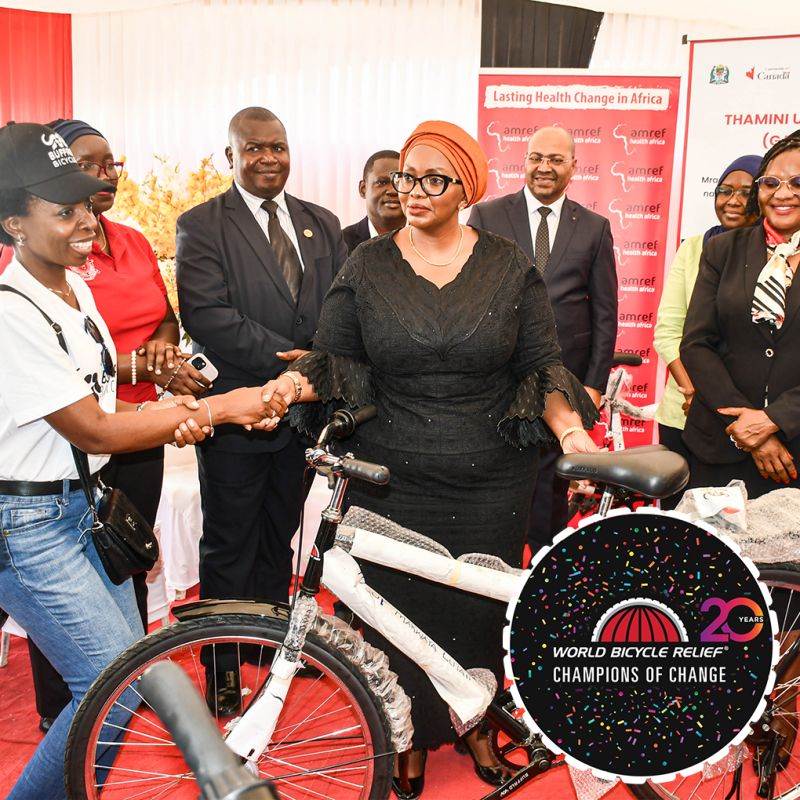
By Amref Health Africa, in partnership with World Bicycle Relief and IDinsight
A landmark study released this week underscores a truth long recognised by Africa’s frontline health workers: bicycles are a critical but often overlooked link in delivering timely primary healthcare in rural communities. Conducted by World Bicycle Relief, in partnership with IDinsight, the two-year randomised controlled trial in Zambia’s rural Mumbwa District demonstrates that reliable bicycle transport—supported by trained mechanics, spare parts, and local shops—can strengthen primary health systems, extend the reach of care, and build resilience against future climatic and economic shocks. By giving community health workers and households the ability to travel farther, faster, and more safely, the study highlights how a simple bicycle can become one of the most cost-effective tools for advancing universal health care coverage and sustainable healthcare access across Africa.
The study followed more than 1,300 adults and community health workers (CHWs) over two years—a period that coincided with one of Zambia’s worst droughts in four decades. In the first year, households and CHWs with bicycles were able to maintain income and access to essential services, while the control group saw a steep decline. In the second year, recovery accelerated for bicycle recipients: CHWs with bicycles earned 70% more income than those without, reflecting how mobility directly supports livelihood stability and service continuity. They also used their bicycles six more times per month to transport patients to health facilities, improving timeliness and consistency of care. The data provide rare, causal proof that when health workers and households can move efficiently, they not only recover faster from shocks—they deliver stronger, more resilient healthcare systems in the process.
Why this matters for sustainable primary healthcare
Across the communities where Amref works, CHWs often walk long distances, limiting daily coverage and delaying time-sensitive services. Reliable bicycle mobility changes that equation—reducing travel time and fatigue, increasing daily reach, and improving referral timeliness for maternal, newborn, and child health, immunisation, and community case management. Beyond improving service delivery, the study also shows that bicycles have a multidimensional impact: CHWs with bicycles experience greater economic stability, higher incomes, and improved wellbeing—factors that strengthen their own health and enable them to provide more consistent, motivated care to the communities they serve.
“These findings reinforce what we see every day across Africa’s health systems—that reliable transport is fundamental to timely, equitable care,” said Ms Vivian Sakanga, the Amref Zambia Country Manager. “The evidence from Zambia shows that when community health workers have bicycles, they reach patients faster, deliver more consistent follow-up, and strengthen the continuity of care in the hardest-to-reach areas. Our partnership with World Bicycle Relief demonstrates what’s possible when we invest in the tools that make health systems work for everyone.”
Key findings that matter to health systems
- Faster recovery where bicycles are present. Households with bicycles rebounded more quickly than those without—turning saved travel time into higher productivity, income, and better living standards.
- Timelier access to care. CHWs with bicycles transported sick patients ~6 more times per month than CHWs without, improving referral timeliness to clinics and health facilities.
- Proven cost-effectiveness. According to IDinsight’s cost-effectiveness analysis, a single bicycle in the hands of a Community Health Worker enables them to serve 2,811 additional clients over five years—or approximately 1,297 additional clients for every $100 invested in the programme.
- Women moved ahead fastest. Women with bicycles earned ~50% more income and saved ~70% more per month than women without; their households also grew assets by nearly $92 more than non-recipients.
- Income and micro-enterprise gains. Among livelihood group members, average monthly income reached ~$29 (+37% vs. control); small businesses earned ~28% more monthly revenue (~$10).
- Time saved = productivity. Bicycle users reported ~1 extra productive hour per day and 30% less reliance on motorised transport.
- Food security and diet quality improved. Households with bicycles had 11% higher dietary diversity and reported fewer periods of food shortage.
- Sustained use and sharing. Two years in, 91% rode daily or several times per week, and 85% shared their bicycles—demonstrating durable value and community benefit.
A call to action for Africa’s health sector
The evidence from Zambia sends a clear message to Africa’s health sector: mobility must be treated as essential health infrastructure. To build stronger, more resilient systems, governments, donors, and implementing partners should integrate bicycles into community health programmes to expand coverage, budget for the full ecosystem of maintenance and spare parts to keep bicycles moving, and measure mobility as a core health systems indicator—tracking time saved, households reached, and referrals completed. As this research shows, when community health workers and households can move efficiently, care becomes timelier, livelihoods grow stronger, and resilience takes root. Investing in bicycle mobility is investing in sustainable, equitable healthcare for all.
Access the report here.