
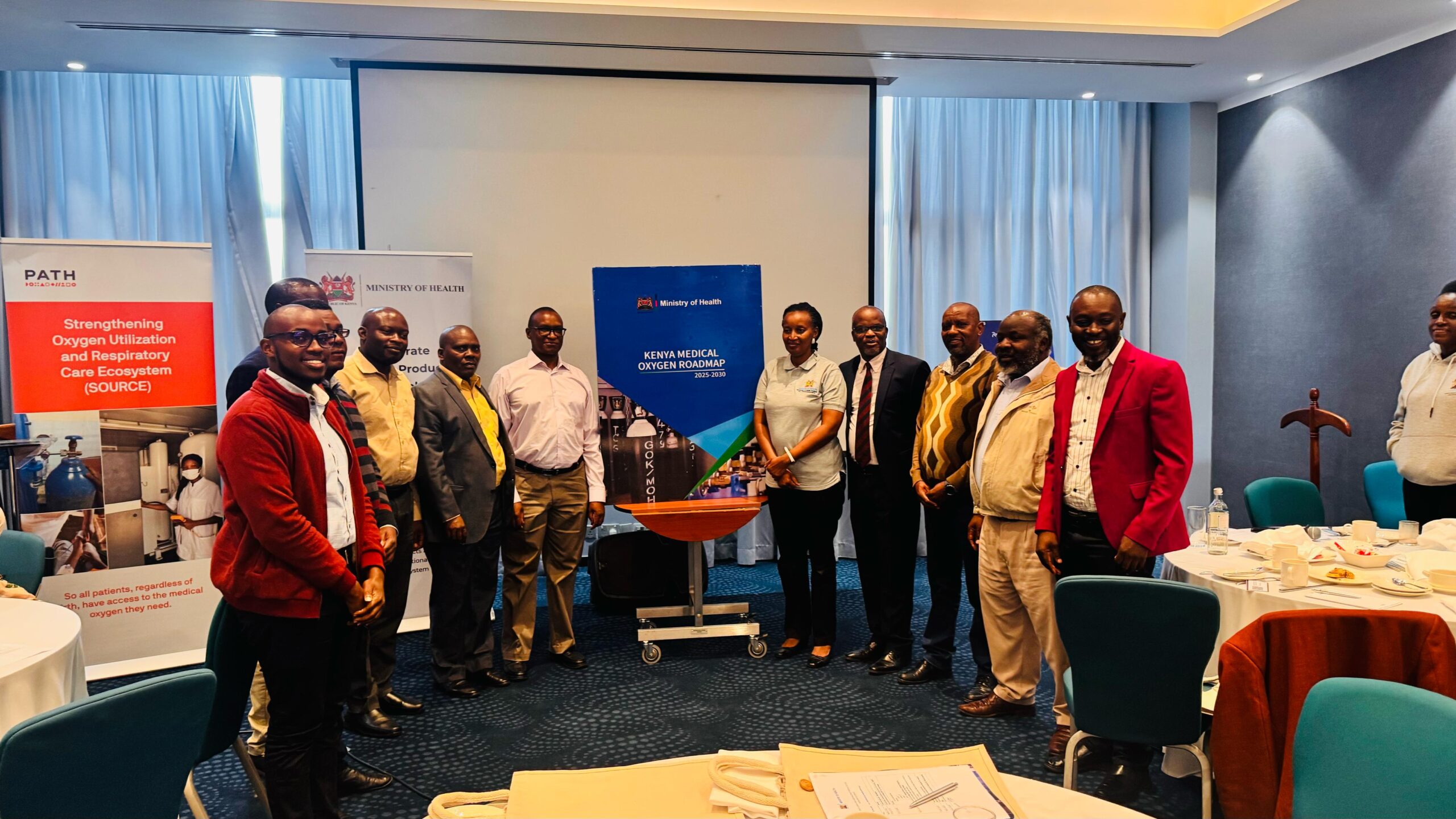
Nairobi – Wednesday, May 14th, 2025: Amref Health Africa joins the Government of Kenya and health sector partners in celebrating the official launch of the Kenya Medical Oxygen Roadmap 2025–2030 — a bold, strategic framework to ensure sustainable, equitable, and uninterrupted access to medical oxygen across the country. The launch marks a major milestone in Kenya’s journey toward universal health coverage and strengthening its primary healthcare system.
The event, convened by the Ministry of Health, brought together county leadership, technical experts, and development agencies. In attendance on behalf of the Ministry of Health was Dr. Tom Menge, Director, Directorate of Health Products and Technologies, who underscored the role of coordinated action in building a resilient national oxygen ecosystem.
“This strategy is a landmark step in our mission to improve access to critical care,” said Dr. Menge. “The Roadmap reflects the commitment of government and partners like Amref Health Africa to deliver health solutions that are locally driven and nationally scaled.”
Medical oxygen is a vital component of routine and emergency care, used in treating respiratory illnesses, managing surgical and trauma cases, supporting newborns in distress, and stabilizing maternal complications. Despite its critical importance, oxygen access in Kenya has historically been limited, especially in lower-level health facilities and rural areas.
While progress has been made, demand continues to far outpace supply. A 2024 analysis by the Clinton Health Access Initiative (CHAI) estimated Kenya’s annual medical oxygen requirement at 64.2 billion litres, but current production capacity stands at just 12 billion litres, less than 20% of what is needed.
The impact of this shortfall is most severe in maternal and newborn care. Preterm births alone consumed over 10.6 billion litres of oxygen in 2024, with babies born before 28 weeks requiring the largest share. Meanwhile, women suffering from post-partum haemorrhage (PPH) — one of the leading causes of maternal mortality — required an estimated 3.3 billion litres. Combined, maternal and neonatal cases accounted for nearly a quarter of the country’s total oxygen demand.
Only 17% of health facilities in Kenya have on-site oxygen generation. Many continue to rely on oxygen cylinders, which are often expensive, difficult to transport, and inconsistently available, particularly in remote counties.
The Kenya Medical Oxygen Roadmap 2025–2030 provides a comprehensive, costed strategy designed to close the country’s oxygen gap and ensure no patient is left behind. Backed by a KES 37 billion investment plan, it provides a blueprint for expanding production, improving storage and delivery systems, and integrating oxygen into county health plans and health financing structures.
At the heart of the roadmap is a focus on efficiency and sustainability. Hospitals are being equipped with piped oxygen systems, which connect multiple cylinders to central delivery points, reducing wastage and enabling multiple patients to be treated simultaneously. These systems are already in use in several counties, improving reliability and reducing costs.
The Roadmap also prioritizes capacity building — training biomedical engineers, health workers, and facility managers to operate and maintain oxygen systems safely and effectively. This people-centred approach ensures that the investments translate into consistent care for those who need it most.
To coordinate implementation, the Ministry of Health has established the Medical Oxygen Partners’ Alliance, bringing together government, counties, private sector actors, training institutions, and civil society. This alliance will support joint planning, promote accountability, and strengthen data systems for real-time monitoring of oxygen availability and usage.
Kenya’s leadership on medical oxygen sets an important precedent for the region. With more than 500,000 child deaths from pneumonia annually across Africa due to limited oxygen access, the Roadmap serves as a replicable model for African countries striving to strengthen primary health care and emergency preparedness.
About the C19RM Project:
The C19RM Medical Oxygen Project, a KES 6 billion (USD 41.7 million) investment supported by the Global Fund and implemented by the Ministry of Health in partnership with Amref Health Africa and county governments, is a transformative investment to expand equitable access to medical oxygen and strengthen Kenya’s health system. This includes the installation of oxygen plants, training clinical and technical personnel, and supporting counties to integrate oxygen into essential health services. To date, the project has delivered over 20,000 oxygen cylinders, installed 22 generating plants, and commissioned 14 bulk storage tanks across all 47 counties. By boosting local production and introducing piped distribution systems that improve efficiency and reduce waste, the initiative is enhancing service delivery in underserved areas and accelerating Kenya’s progress toward universal health coverage.