
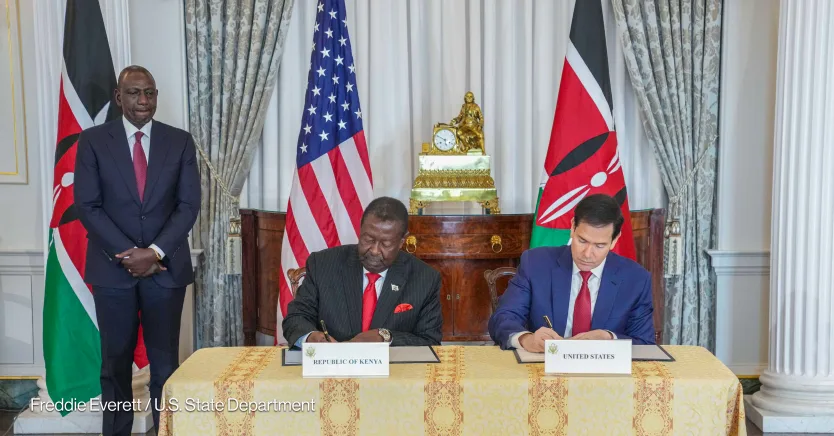
Kenya made a pragmatic choice in a crisis. However, that shouldn’t require sacrificing principles and the world should build systems where developing countries can access critical health funding without having to choose between investment and sovereignty.
By Githinji Gitahi // 12 December 2025
The question many have asked me — is the Kenya-U.S. health deal good or bad? My answer is that it’s neither good nor bad — it’s pragmatic at best; more complex than black or white, and this is why.
At face value, a U.S. commitment of $1.6 billion over five years looks like an unequivocal win for Kenya’s health system: cutting-edge laboratories, digital health systems, better-trained health workers. To put this in context, a contribution of $320 million annually in a country where total general government expenditure on health is just slightly above $2 billion means America’s “gift” is almost 15% of Kenya’s total general public expenditure. Simply put, America is “gifting” Kenya about $5 per capita in a country where the government spends $43 per capita.
It is understandable why many see this as a generosity that Kenya should simply accept. But should Kenya look a gift horse in the mouth? If Kenya did look the gift horse in the proverbial mouth, the teeth would reveal a fundamental decay in how wealthy nations now conduct global health partnerships and Kenya’s constrained position in negotiating them.
For decades, the United States positioned global health as a moral obligation and a pillar of security. The U.S. Agency for International Development’s founding philosophy in 1961 was based on the principle that keeping other nations safe helped keep Americans safe too. That era has ended. The current U.S. foreign policy doctrine has explicitly reframed foreign assistance as a tool of American statecraft to advance national interests.
This isn’t a minor change. It represents a fundamental reorientation that global health assistance is no longer primarily about saving lives. It’s about securing strategic partnerships, building American companies, and controlling access to biological resources.
The shortcomings of bilateral agreements
Kenya did not choose this arrangement because it was the ideal one. Kenya chose it because the alternative was potentially catastrophic. When USAID paused operations earlier this year, Kenya’s health system experienced a crisis when thousands of health workers faced layoffs, HIV treatment programs stalled, vaccination campaigns were under threat, and maternal and child health services faced cancellation.
This situation reveals the core problem with bilateral deals. They can allow powerful countries to exploit the desperation of weaker ones. Kenya needed funding. America had it. America, therefore, had leverage to demand conditions that might not survive scrutiny in a balanced negotiation.
While Kenya rightly rejected a specimen-sharing agreement, the final text does allow for joint testing and the sharing of pathogen genetic sequences in line with Kenyan laws. And this is where the critical gap lies. Even without physical specimens, pathogen sequence data alone can enable the development of vaccines, diagnostics, or therapeutics. If American institutions use Kenyan pathogen data to develop high-value products, what benefits are guaranteed to flow back to Kenya? The agreement is silent.
Without explicit benefit-sharing provisions, Kenya risks contributing biological data of immense commercial value without a clear pathway to equitable returns.
To its advantage, Kenya has strong domestic laws. Its 2025 Access and Benefit Sharing Regulations explicitly require benefit-sharing for genetic resource use. But these protections only work if Kenya actively enforces them, and the bilateral agreement with the U.S. doesn’t make that easy. In the current agreement, benefit-sharing was deferred to future negotiations with no deadline specified. The most troubling aspect of this, however, is what this signals about global health cooperation.
The broader global picture is equally troubling. For years, countries have been working through the World Health Organization to establish a pathogen access and benefit sharing, or PABS, framework meant to create a fair system for sharing pathogens and ensuring equitable access to resulting benefits. The United States withdrew from these negotiations and is instead striking bilateral deals across Africa. For America, these deals are faster, easier, and give preferential access. Meanwhile, the global PABS system struggles because countries are signing away their pathogens bilaterally.
The result is that wealthy countries bypass global negotiations by offering bilateral incentives, and the entire multilateral system weakens.
“If American institutions use Kenyan pathogen data to develop high-value products, what benefits are guaranteed to flow back to Kenya? The agreement is silent.”
What should Kenya have done differently?
Ideally, Kenya should have negotiated explicit benefit-sharing upfront. The agreement should specify what Kenya receives if companies profit from Kenya’s pathogen data, with guarantees on vaccine access, technology transfer, or financial payments.
Additionally, Kenya should have tied the agreement more explicitly to the emerging WHO PABS framework, in which Kenya was involved in negotiating alongside other African countries. Any bilateral pathogen sharing should be subordinate to multilateral frameworks, ensuring Kenya’s interests are protected globally, not just bilaterally.
Instead, the agreement leaves benefit-sharing to future negotiation with no timeline — putting the cart ahead of the gift horse, to mix imagery. Kenya should have insisted on a six-month deadline and put some bilateral pressure on America.
At the public level, concerns about data privacy and sovereignty are valid. While the agreement promises real health gains for Kenya, it also creates anxieties over how sensitive data will be used, shared, and protected.
Before sharing sensitive personal health data with other countries, there have to be clear rules and protections in place. In Kenya’s case, the legal framework exists, but the safeguards themselves have yet to be negotiated. Both governments, and indeed any country entering similar bilateral agreements, should agree on these data protection protocols before the system goes live: what data may be shared, how it will be secured, who will access it, and how individuals can have a say in what happens to their information.
This is not about stopping the partnerships, but it’s about making sure it’s done in a way that protects citizens while still getting the health benefits they need.
So, is this a good or bad bilateral agreement?
Truth is that with a contribution as significant as 15% of Kenya’s existing general tax expenditure on health, Kenya’s health system will be stronger. However, the agreement sets a precedent, and America has similar deals in the pipeline with many other African countries. If Kenya ends up giving away its biological resources without fair compensation, it establishes a terrible template.
Africa holds some of the world’s most important disease reservoirs. If African countries sign away their resources without ensuring fair benefit-sharing already proposed under the multilateral PABS, they undermine the global cooperation system humanity needs for the next pandemic.
Article first published on: https://www.devex.com/news/the-kenya-us-health-deal-is-pragmatic-but-could-have-been-done-better-111543?skip_optional_steps=true