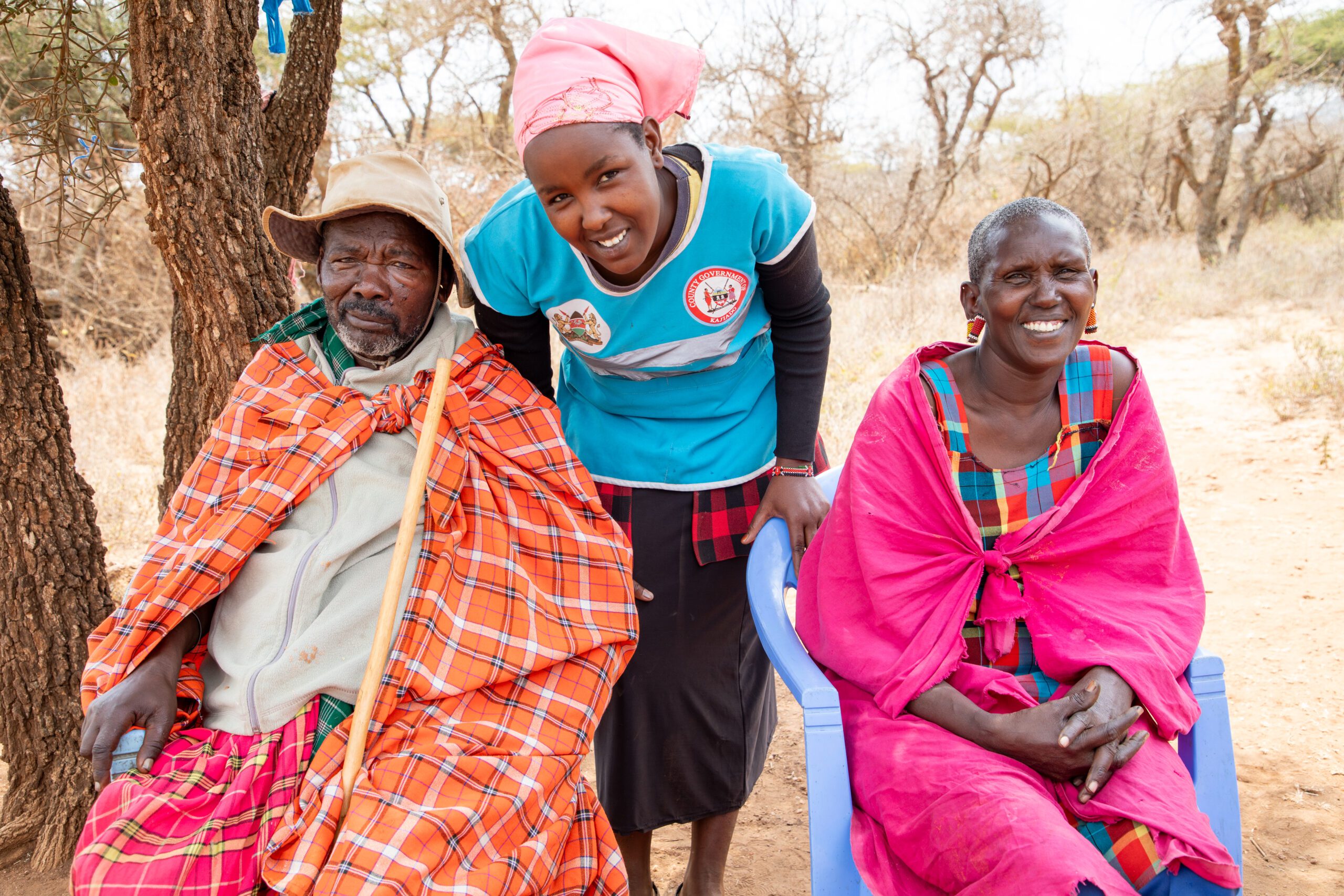
In the quiet village of Odekesi in Enkaroni, Kajiado County, a routine health outreach under the Saving Lives and Livelihoods (SLL) project became a turning point for 70-year-old Mr Lesalon Naikuni, a father, elder, and well-known member of his community.
The SLL project, funded by the Mastercard Foundation in partnership with Africa CDC and implemented by Amref Health Africa together with the Kajiado County Government, regularly deploys health teams to remote areas. For many families, these visits bring the only accessible health services they receive all year.
For Mr. Naikuni, the visit came just in time.
He had been feeling unusually weak for months. Walking had become difficult, and even simple tasks required support. Like many older adults, he assumed it was simply old age catching up with him. He knew he had high blood pressure, but he never imagined that a much more serious problem was quietly threatening his life.
When community health promoters (CHPs) informed him that health workers were coming to the village, he decided to attend, supported by his wife, Mrs Roda Lesalon, who is also battling her own health conditions.
At the outreach clinic, practitioners checked his vitals and performed a simple blood sugar test. The results were shocking. His blood sugar level was 31 mmol/L, more than four times the upper normal limit. Without swift action, he could have suffered life-threatening complications.
Health workers immediately referred him to Kajiado County Referral Hospital, where he was diagnosed with diabetes and placed on urgent treatment.
For Mr Naikuni and his wife, the diagnosis brought fear but also relief. The mystery behind his declining health now had a name, and he finally had access to care.
Today, he is on regular medication for both diabetes and hypertension. Thanks to trained CHPs in his village, he now receives consistent follow-up care without leaving home. His strength is slowly returning, and he and his wife speak of feeling hopeful for the first time in years.
“This outreach saved my life,” he says. “If they had not come, I would never have known what was wrong with my health.”
Mr Naikuni’s story is echoed across the vast plains of Kajiado, where health facilities are often hours away and transport costs are high. For many families, health services come only when health workers come to them.

The SLL project’s integrated outreach clinics have become a lifeline for thousands. On a single outreach day, community members receive:
- routine childhood vaccinations
- family planning services
- screening for hypertension, diabetes, and other NCDs
- essential health education
- referrals for advanced care
- and in some cases, emergency support
For mothers, this means their children get vaccinated without long journeys, thus saving them adequate time to focus on their economic activities. For men, it offers a chance to participate in preventive care. For the elderly, like Mr Naikuni, it brings lifesaving screening and treatment.
These outreach clinics are more than medical events, they are moments of connection, trust, and dignity. They restore hope to families who often feel left behind by the health system.
As the SLL project continues to expand this integrated One Health approach, communities across Kajiado are experiencing firsthand what it means for health systems to come to them, not the other way around.
And sometimes, like in Odekesi, one outreach visit can mean the difference between life and loss, between despair and renewed strength.

Author: David Mitine, Communications Officer, Amref Health Africa