

“Before the bicycle, I would set out at dawn and still not finish my rounds,” says Patrick Wabuko, a Community Health Promoter (CHP) based in Khunyangu, Busia. “The furthest household I serve is three kilometres away. It used to take me almost four hours just to get there.” With 125 households under his care, Patrick could only reach five to eight families each day. But everything changed when he received a bicycle on Friday, 9th May 2025 during the launch which was held at Khunyangu Sub-county Referral Hospital, Busia County.
Now, based on his early experience, he believes he can manage 10 to 15 household visits daily. “It will save me so much time. I can follow up on referrals, monitor children’s immunisation schedules, and educate families on malaria prevention far more consistently.”
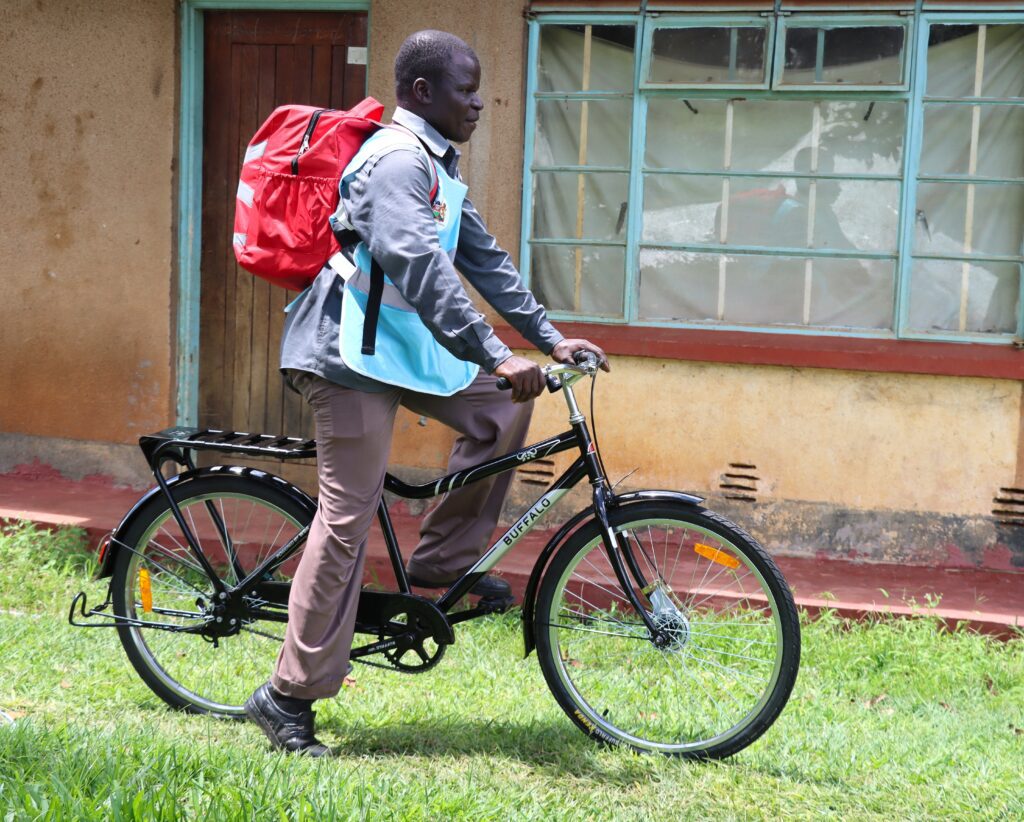
Patrick is one of 210 CHPs who recently received bicycles through the Primary Health Care for Malaria Elimination (PHC for ME) project, a joint initiative by Amref Health Africa and World Bicycle Relief in partnership with the Busia County Government, sponsored by GSK. The initiative aims to strengthen the delivery of primary health care by addressing a core barrier: mobility.
Though the launch event at Khunyangu County Referral Hospital on Friday 9th of May 2025 saw 80 bicycles distributed, the effort extended further 60 were delivered in Bumala and 70 in Teso North. Each bicycle handed over is a powerful tool in the broader push toward Universal Health Coverage (UHC): enabling CHPs to bring essential services to underserved, rural communities.
“Malaria prevalence in Busia stands at 38%, nearly five times the national average,” said Gilbert Wangalwa, Deputy Country Director at Amref Health Africa in Kenya. “This project is about equipping CHPs with practical tools that support early diagnosis, treatment, and follow-up. With every bicycle, we’re moving closer to a future where no one is left behind.”
The intervention also recognises the role of climate-resilient, sustainable solutions in public health. “Bicycles are a zero-emission transport method,” noted Dennis Mukundi Kinyua, Project Manager. “They align with our shared goals on climate action and resilient health systems.”
To ensure this impact is measurable and transparent, Amref rolled out a performance monitoring tool during the event. The tool collects real-time data to assess how improved mobility affects service delivery, disease detection, and prevention.
In parallel, a baseline survey using Kobo Tool is ongoing. “We would like to evaluate how bicycles influence malaria indicators i.e. vaccine uptake among children under 2 years and expectant women, referral rates, maternal health outcomes, among other health indicators,” explained Rose Betty, Monitoring, Evaluation and Learning Officer. “By tracking CHPs’ progress over three, six, and twelve months, we’ll understand what’s working and where to adjust.”
The ceremony also saw support from H.E. Hon. Dr. Arthur Odera, Deputy Governor of Busia, who emphasised the county’s commitment to community health. “Community Health Promoters are the backbone of our primary healthcare system, managing approximately 70% of the malaria burden in our county through household testing and treatment of uncomplicated cases,” said Deputy Governor Hon. Dr. Arthur Odera during the handover ceremony. “We’re investing in tools and training, from oxygen tanks to ultrasound machines, to support CHPs in every way. Malaria prevention begins at the household level, and CHPs are central to this mission. This initiative is a critical part of strengthening our community health systems and advancing malaria prevention at the household level.”
The event’s energy was not just symbolic; it was deeply personal. As Patrick mounted his bicycle and pedalled away from the hospital, he wasn’t just heading home. He was accelerating access to health care for dozens of families who once waited days or weeks for visits. What used to be a slow, exhausting walk is now a brisk ride. And with that, a healthier future for the community is now within reach.
A Brighter Future Beyond Busia
The impact of this intervention extends beyond just faster visits and increased reach. By enhancing the efficiency of CHPs’ work, the bicycle initiative is also contributing to the economic resilience of local families. With fewer cases progressing to severe illness due to early intervention, households are spared the financial burden of frequent hospital visits and treatment costs. This means families can retain and reinvest their limited resources within their homes.
While the current phase of the project has reached Busia, similar efforts are soon to unfold in Siaya, where 210 bicycles will be distributed to CHPs, empowering them to further transform the landscape of community health and malaria prevention.
By enhancing access to primary health care through community-led solutions, this initiative not only contributes to SDG 3: Good Health and Well-being, but also advances Kenya’s Universal Health Coverage agenda and aligns with Amref Health Africa’s Big Bet on Primary Health Care, which prioritises community resilience and stronger health systems across Africa.
In the quiet hum of bicycle tires over rural roads lies a powerful message: progress doesn’t always roar. Sometimes, it pedals.
About the Project:
The Primary Health Care for Malaria Elimination (PHC for ME) project is a three-year initiative funded by GSK and implemented by Amref Health Africa in Kenya and Zambia. Its main objective is to strengthen primary health care systems to improve the prevention, diagnosis, treatment, and surveillance of malaria, particularly in high-burden regions. The project focuses on building community and health system capacity, enhancing supply chain management, promoting the uptake of preventive interventions including the malaria vaccine, and integrating responses to emerging threats such as climate change and antimicrobial resistance. Through targeted support to frontline health workers, community engagement, and policy advocacy, the programme aims to deliver sustainable, people-centred health outcomes and contribute meaningfully to national and global malaria elimination goals.
Author: Blessings Ngode, Communication Intern, Amref Health Africa.