
It’s Thursday.
Simenti begins his day long before the intense Malawian sun, that lone daytime traveller rises over the dusty, flat fields of central countryside. In the summer, the sun comes up before six in the morning, so he wakes early to beat the heat and make sure he’s on time for his rounds.
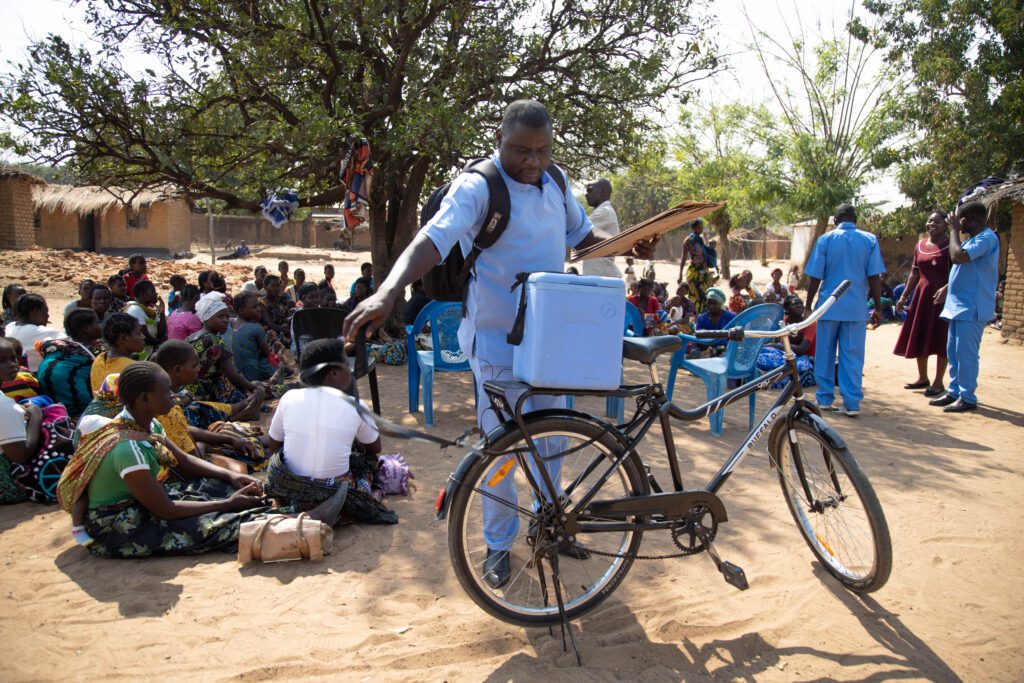
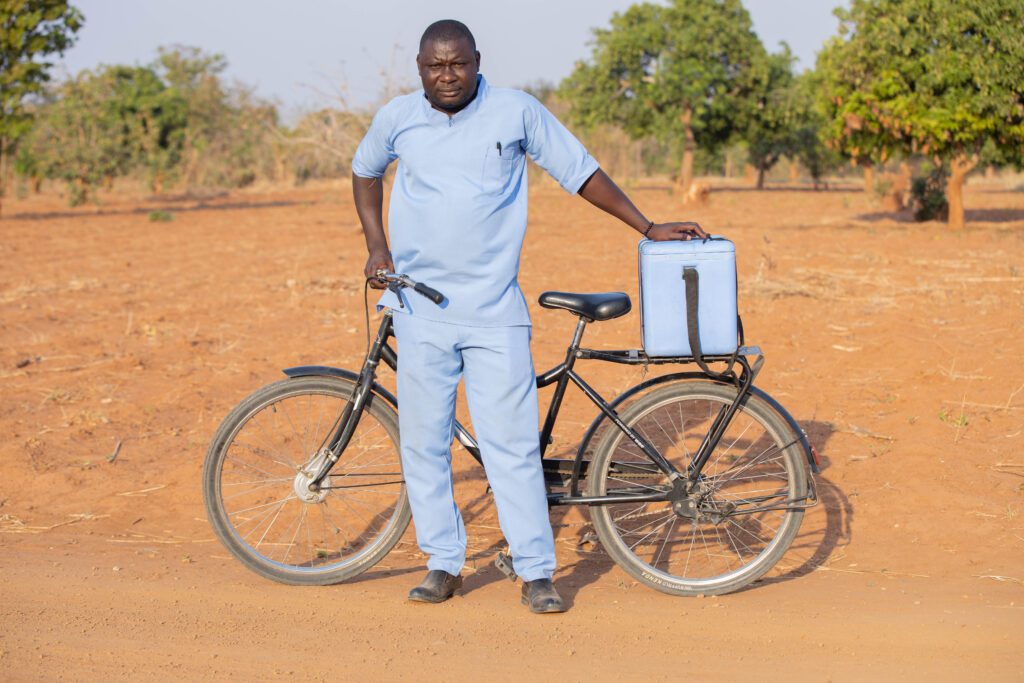
Today, he’s heading to Katenje, a village about twenty kilometres away in Kasungu District, central Malawi. Here, the morning feels cool, but for Simenti, having cycled now for nearly twenty kilometres, the sweat on his face tells a different story. “I do this several times a week. I take the vaccines in the morning to the outreaches and bring them back (to the health centre) in the evening,” he explains.
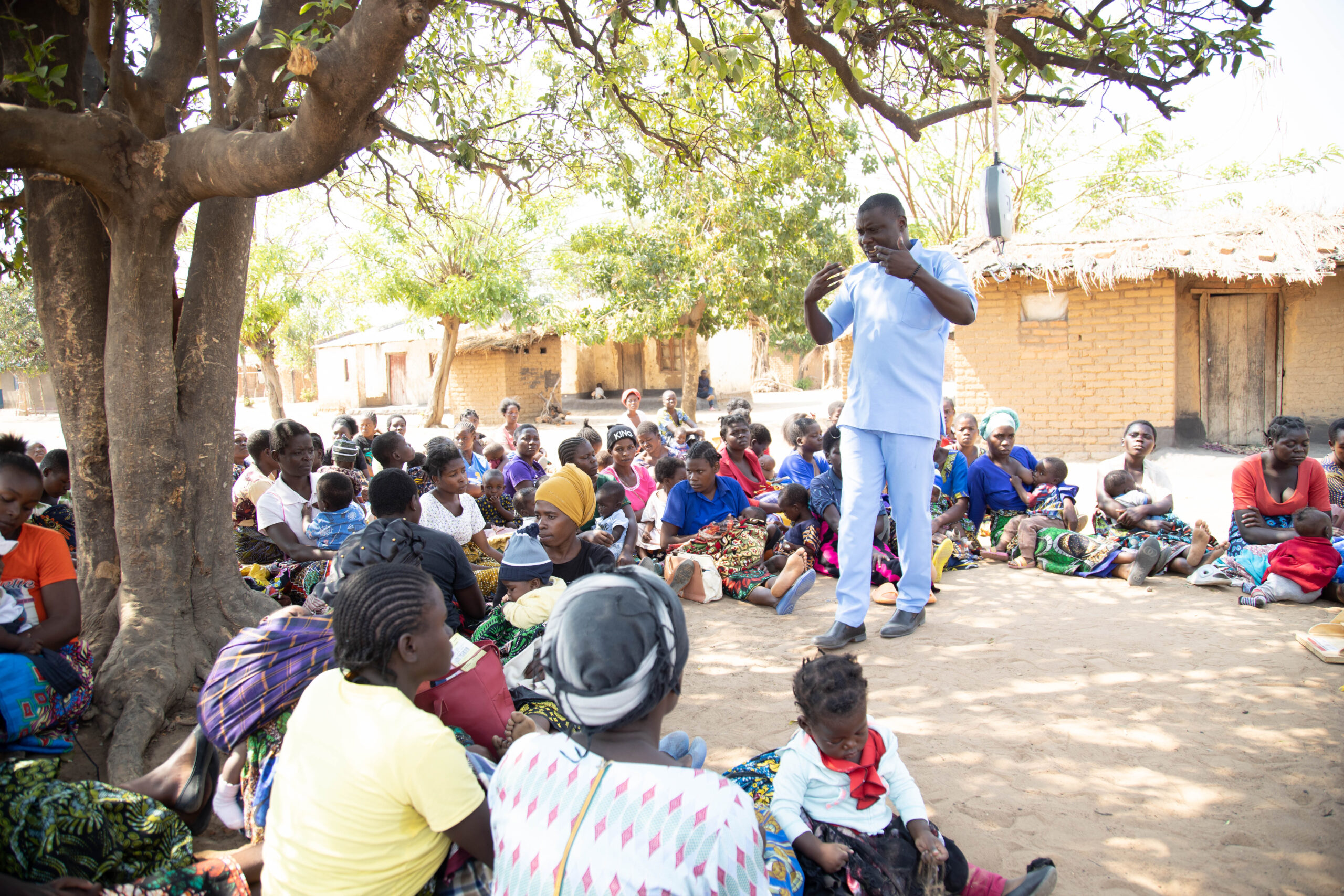
He’s hot and breathless as he nears the village. His destination is a familiar spot: a small gathering area under a huge lemon surrounded by clusters of thatched brick-walled houses. A few plastic chairs and tables borrowed from nearby families serve as a makeshift clinic. Goats wander by looking for shade, dogs curl up in a cool corner, and mothers seated on bare ground chat as they wait for the clinic to begin. Toddlers chase each other around, their squeals blending with the women’s chatter. Occasionally, a baby cries impatiently, but it’s quickly soothed.
“This is our monthly outreach clinic,” he explains “We have about 21 outreach sites across this district, each with its own scheduled day.” Twenty-one outreaches in a month covered by a few community health workers is a stretch! In Kasungu distances can feel deceptively short until you have to travel them yourself, especially if your only mode of transportation is a bicycle.
Originally, Fanizo Simenti, who hails from the capital, Lilongwe, dreamed of becoming a teacher. But a far greater need for community health workers convinced him otherwise. “A health worker must have integrity and love for the job and for the people,” Simenti explains. “And you need good communication skills so the community can understand you and you can understand them. Without that, you can’t deliver.” He has strong eyes. His well-built frame towers over everyone, yet his quiet nature softens his presence. He speaks softly and gently and occasionally laughs between conversations with other community health workers.
In Malawi, 83% of the population of 19 million lives in rural areas, with extremely limited access to doctors and nurses. The World Health Organisation (WHO) classifies Malawi as a country experiencing a global health workforce crisis: there are only about 0.2 doctors and 3.4 nurses or midwives for every 10,000 people (WHO, 2014). This stark shortage means that for many rural families, community health workers like Simenti offer the only hope for urgent care, health education, and preventive services. Simenti is among Community Health Workers trained by Amref Health Africa in Malawi, as skilled healthcare workers to deliver key health services at the community level.
In 2022, Malawi had its first polio case in 30 years. It also faces recurring outbreaks of typhoid fever, measles, COVID-19, and annual cholera outbreaks. All these illnesses are preventable with the right vaccines, but that only works if vaccines can reach the people who need them most. Trained Community Health Workers deliver them, sometimes under the shade of a tree, and save lives.
A Matter of Life and Death
“People here are poor,” he puts it plainly. “Even a short journey can be impossible if you don’t have money for transportation.” In one tragic case, he recalls, a mother who lost her child before they could reach the hospital.. “Yeah, we had a woman,because of the distance to get medication, she lost her child,” Simenti recalls quietly. “They tried to go to the hospital, but they couldn’t afford fast transport. By the time they got there, the doctor said the child had already died.” When a trained CHW is nearby, they can diagnose an illness early and administer lifesaving treatment. This is often the difference between a family losing a child and being able to celebrate that child’s next birthday.
Outreaches are the busiest days for Simenti. They begin with a familiar Chichewa song and dance performed by community health workers an uplifting tune that carries a message about healthy living. He claps his hands and moves his shoulders gently to the melody. Then, the real work begins as women queue up.
But the challenges at each community health outreach site are real. Often, there’s no permanent shelter, so they work under a tree. If it rains, they have no choice but to cancel and postpone, leaving families without the care they need. “In my outreach, there’s no shelter,” he explains. “We sit under a tree and provide services. During the rainy season, we can’t do that, so we have to cancel. That means people go without care for days or weeks.”
In rural areas of central Malawi, where healthcare infrastructure is still developing, makeshift clinics often under a tree or in other informal shelters become life-saving points of care. Amref Health Africa is working to establish more of these integrated outreach clinics in remote areas, such as Katenje, ensuring vital services are within reach, even if that means providing care under the shade of a tree.
In rural areas of central Malawi, where healthcare infrastructure is still developing, makeshift clinics often under a tree or in other informal shelters become life-saving points of care. Amref Health Africa is working to establish more of these integrated outreach clinics in remote areas, such as Katenje, ensuring vital services are within reach, even if that means providing care under the shade of a tree.
Bringing Healthcare Closer
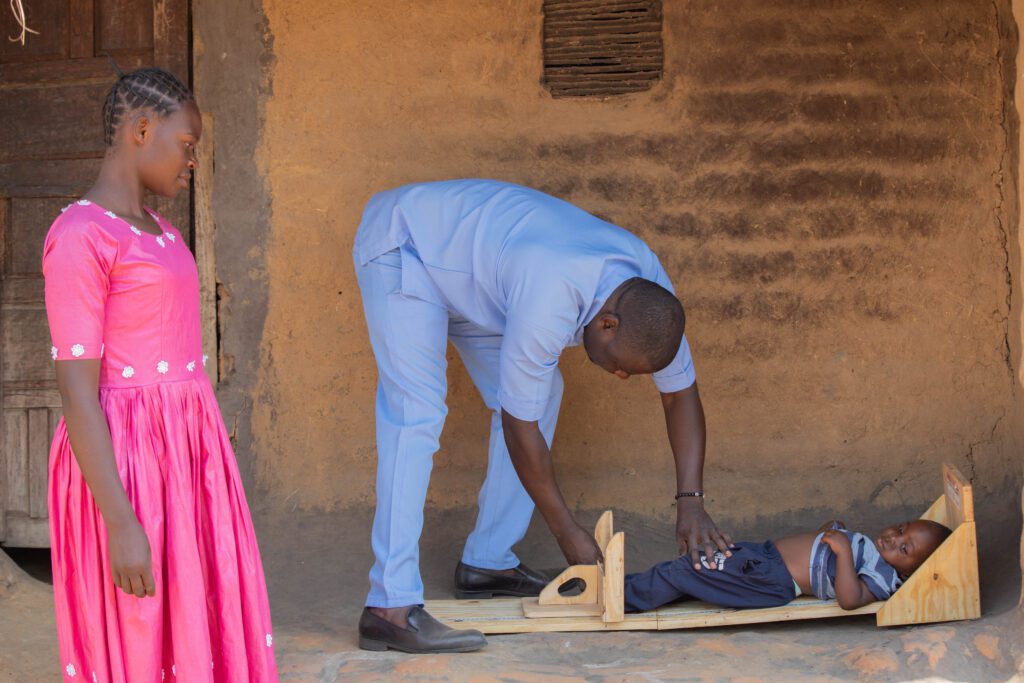
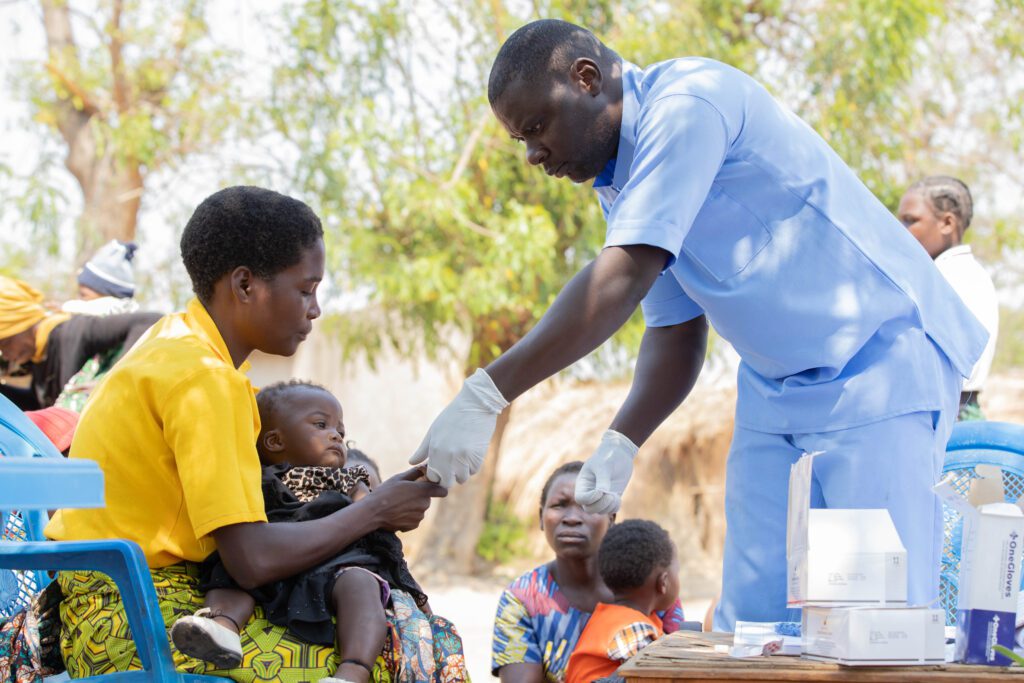
Simenti’s responsibilities are wide-ranging. Known locally as the “village doctor,” he provides preventive and curative services for the under-five children, including care for malaria, pneumonia, diarrhoea, and red eye infections and other preventable diseases. He works under the guidelines of the Expanded Program on Immunization (EPI), vaccinating children to protect them from deadly diseases. He also monitors growth and nutrition status, giving parents vital education on how to keep their children healthy.
“For me, as a health service assistant, I have a vital role which mediates the health centre and the community,” Simenti explains. “We take services close to the community, like we do preventive services, vaccinations, and treat under-five children with selected diseases. We are bringing essential health services close to the family.”
Trained by Amref Health Africa, Simenti is now fully equipped to vaccinate children and support mothers with antenatal care in remote areas. Together with other trained community health workers, they have so far provided services closer to communities in hard-to-reach areas, delivering integrated family health services to nearly half a million people. This includes antenatal care for nearly thirty thousand women and immunisations for seventy thousand children below the age of five.
“Yes, I love the community,” he adds. “When I call a meeting to discuss health issues, people come.”
Besides running these health outreaches, home visits are also crucial. Part of his role includes going to houses to spread health information, check on pregnant women, and offer care for new mothers and their babies. By catching warning signs early, he helps prevent minor risks from becoming life-threatening crises.
The Training
One community health care worker in Malawi may be responsible for over 1,000 households, far exceeding the government’s ideal of 1:500. Some areas rely on volunteer CHWs who haven’t had any formal training, yet struggle to fill the massive healthcare gaps. Simenti serves more than 4,300 people, a huge number for just one frontline worker.
In a perfect scenario, every 10 households in Malawi would have a volunteer CHW, requiring about 340,000 CHWs countrywide, an ambitious goal, but one that could transform the country’s healthcare landscape.
Simenti credits the ongoing support and training with giving him the confidence to handle everything from sick children to pregnant women in need of urgent referral. “We know the principles of how we can work and how to provide essential healthcare services close to the family,” he says. “I pray that more people can be trained. If there were ten of us, we could sit together and discuss what we’ve learned, and the community would really benefit.”
In rural Malawi, “benefit” can translate directly to saving lives: Ensuring mums get to skilled birth attendants on time and children receive their immunizations before it’s too late.
For now, hope continues to roll across the Malawian countryside on Simenti’s bicycle. “We love our job as health workers,” he says.
As he cycles back, after a long day at the outreach, he’s greeted by familiar faces of farmers who are ambling home with bicycles and children racing through the last shards of daylight. “It’s very tiring,” he admits, “but because we love the job, we continue.”
Tomorrow is his rest day.
Then it’s back on the bicycle to another outreach, another village, another set of lives that might depend on him and his work.
For many pregnant mothers and families across Kasungu, Community Health Workers like Simenti are their first and sometimes only stop for consistent care.
And he does it all, day after day, on two wheels.
Author: Wesley Kipng’enoh, Fundraising Content Manager