
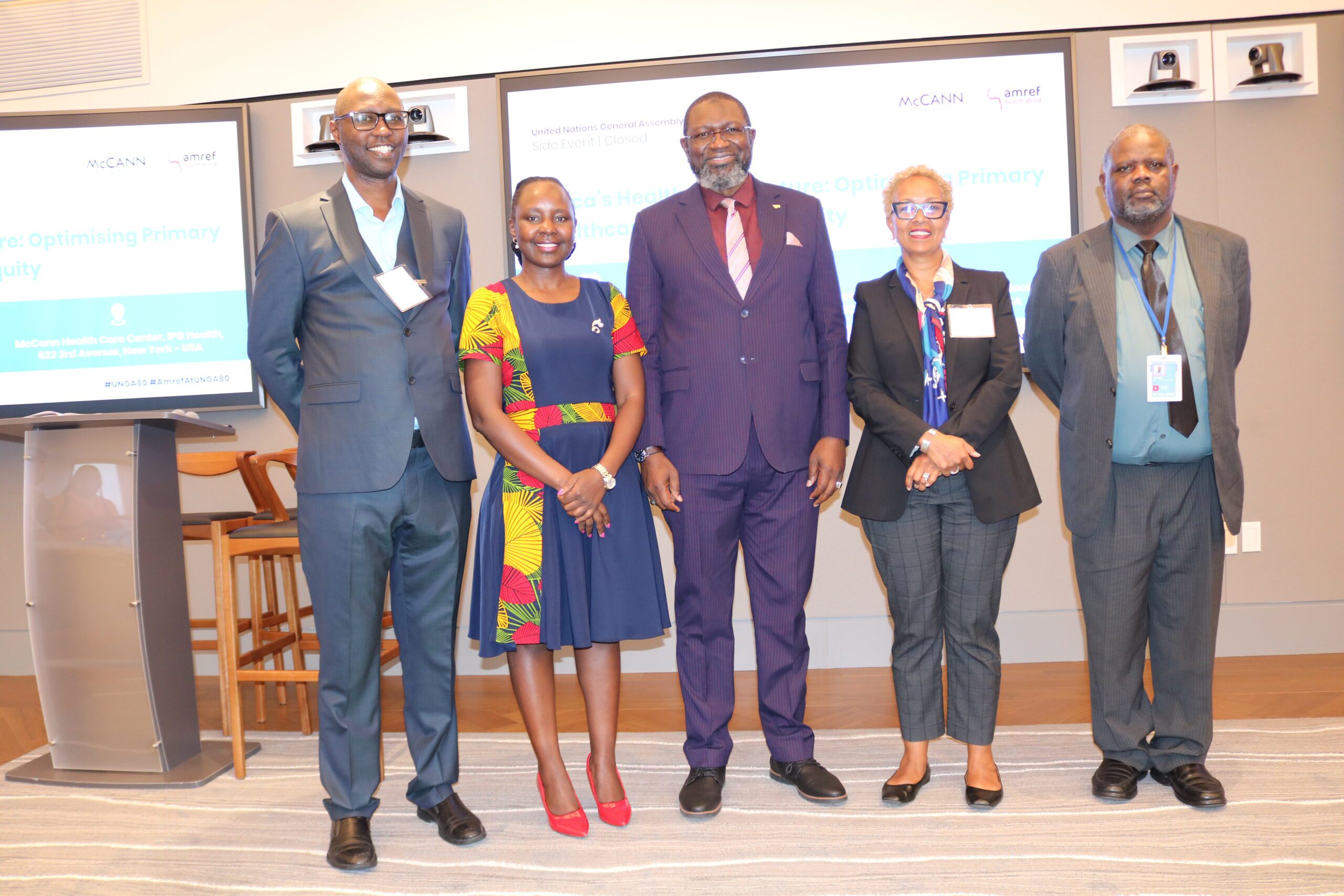
By Boniface Mbuthia, Diana Mukami, Risper Walumbe, Corazon Aquino, Mercy Korir & Charlotte Muheki from Amref Health Africa
As global leaders gathered at the 80th United Nations General Assembly (UNGA) in New York, Amref Health Africa hosted a round table discussion recognizing that Africa’s health architecture stands at a decisive crossroads—where reform is not optional, but existential. Africa’s health systems are at a tipping point. PHC—long hailed as the bedrock of equitable health—is now stretched thin by donor dependency, widespread climate shocks, and shifting geopolitics. Yet within this fragile situation lies profound opportunity: to reimagine PHC not as a charity case, but as a sovereign strategy for dignity, resilience, and justice.
The time for reform is now, and the political momentum is building.
Recently, at The African Health Sovereignty Summit held in Accra on the 5th August 2025, President John Dramani Mahama declared, ‘ Africa must take charge of its health destiny – not in isolation but through determined, coordinated actions’ The summit launched the Accra initiative and the Accra compact, both being bold frameworks aimed at reshaping global health governance to reflect African priorities.
Amref designed the PHC Accelerator: More Than a Toolkit
Amref Health Africa seized the opportunity during the side event to present the PHC accelerator Bundle – a toolkit for reform with the main drivers as follows:
- Community Connect: Professionalize and scale frontline care by deploying polyvalent community health workers who deliver integrated services, strengthen household-level access, and drive retention and responsiveness across the continuum of care.
- Sustainable Domestic Financing: Reclaim fiscal sovereignty by unlocking and reallocating domestic resources through evidence-based priority setting. Align public budgets with PHC goals to expand fiscal space, boost efficiency, and match financing with political commitments and population health needs.
- PHC Leadership Catalyst: Build adaptive, people-centered leadership to accelerate accountability, improve governance, and drive high-performance health systems. Empower local actors to lead implementation, make resilient decisions, and secure long-term health gains.
- Multi-sectoral Data Insights: Activate real-time, cross-sectoral decision-making through integrated data platforms that connect households to national planning. Leverage insights from education, WASH, agriculture, and social protection to enable targeted resource allocation, rapid response, and measurable impact at all levels.
Building on from what exists:
The roundtable rightly challenged the donor-dependent status quo. Noting that PHC must be reframed as a smart economic investment—one that reduces emergency costs, boosts productivity, and builds political legitimacy. Ministries of finance must be shown that health is not just a cost, but a dividend that yields lasting gains for national development
Countries need to rethink how to effectively turn existing out-of-pocket (OOP) spending into pooled schemes, and institutionalizing them towards sustainability in the national budgets, and documenting lessons not just for internal reforms, but for regional solidarity. Africa must speak the language of economics without losing the soul of equity.
Political Will: The Pulse of Reform
Across the continent there are many exemplars that can only be tested or scaled contingent on high political will. PHC must be aligned with the political agendas, where senior government officials, not just technical experts—lead the charge, transform reform priorities into reality. But political will must be nurtured, not assumed. It must be incentivized through peer learning, regional platforms, and public accountability.
Accountability: From Scorecards to Co-Creation
Stakeholders, including the Civil society Organizations (CSOs) must rise as both partners and watchdogs. Armed with Scorecards to track progress and foster true health systems accountability. Efforts must be made to empower communities so that they can help design and demand efficient PHC systems and not merely exist as recipients. As literacy levels in the continent rise and chronic diseases surge, the re-imagined PHC must evolve into advanced care hubs that integrate diagnostics, education, and prevention interventions.
The Verdict: PHC as a Political Act
Africa’s PHC journey is not just about health; it’s about power. It’s about who decides, who funds, and who benefits. To optimize PHC is to assert that African lives are not emergencies waiting to happen, but futures worth investing in.
This is the moment to move from dependency to dignity. From fragmented aid to unified action. From declarations to delivery.
In PHC, we have the heartbeat of Africa’s health sovereignty!