
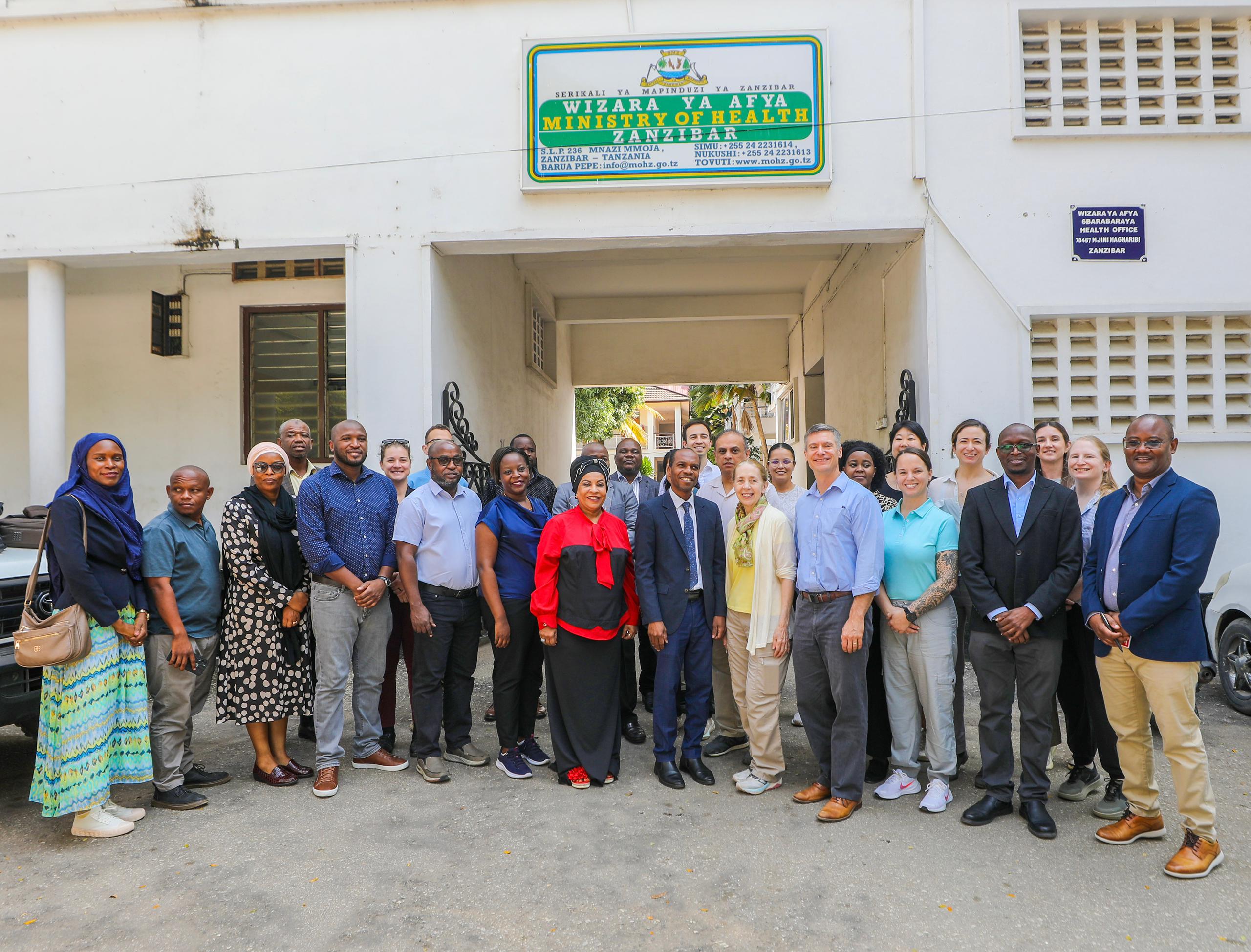
Zanzibar, Tanzania, 11–13 August 2025; Medical officer trainees from the U.S. Military Tropical Medicine (MTM) Programme spent three days in Zanzibar gaining firsthand experience of how local health systems respond to infectious diseases in resource-limited settings. The rotation, coordinated in partnership with the Ministry of Health, Zanzibar, Tanzania People’s Defence Forces (TPDF), U.S. Centers for Disease Control and Prevention (CDC), the Walter Reed Army Institute of Research, and Amref Health Africa in Tanzania, offered the trainees a unique opportunity to immerse themselves in real-world public health practice.
“This visit reflects our commitment to working with global partners to confront shared public health challenges,” said Dr Amour Suleiman Mohammed, Director General of the Ministry of Health, Zanzibar. “By opening our doors to military medical trainees, we are investing in a stronger, more connected global health workforce.”
The programme opened with a high-level briefing hosted by the Ministry of Health, CDC, and Amref, before trainees visited the Zanzibar Public Health Emergency Operations Centre (ZPHEOC). There, they explored how community health workers raise alerts, how District Health Management Teams coordinate data, and how Rapid Response Teams are deployed with support from the Tanzania Field Epidemiology and Laboratory Training Programme.
“Zanzibar has made notable strides in strengthening its public health emergency coordination, and the ZPHEOC is a model of how local systems can be effectively organised,” said Dr Kokuhabwa Mukurasi, Medical Epidemiologist at the U.S. CDC Tanzania. “Through visits like this, we reinforce technical exchange and celebrate the growing capacity of Zanzibar’s health response system.”
“These engagements are not only technical exchanges but opportunities to build lasting partnerships,” added Dr Fadhil Abdallah, Emergency Operations Centre Manager. “We value the curiosity and commitment of these trainees and believe their presence and partnership enhance both local and global preparedness.”
Later, the group toured the Binguni Public Health Laboratory, where they observed diagnostic testing for cholera and Mpox and held discussions with staff on the challenges of managing outbreaks in hard-to-reach environments.
Day two shifted focus to HIV care and treatment at Bububu Military Hospital, a TPDF facility serving both the military and surrounding communities. Trainees engaged with healthcare workers across the continuum of HIV care, from testing to treatment follow-up, and were briefed on Global Emerging Infections Surveillance activities conducted at the hospital.
The final day centred on integrated HIV and substance use recovery services at the Kidongo Chekundu Medication Assisted Treatment (MAT) Clinic. Clients shared powerful personal testimonies. “This clinic gave me more than medicine; it gave me a second chance at life,” said one woman living with HIV who had also received cervical cancer screening. Another beneficiary added: “Before this programme, I had lost everything. Now, I have hope, and I’m rebuilding my life.”
The trainees also visited a nearby community drug-use hotspot, observing income-generating activities led by people in recovery and learning how outreach teams build trust before enrolling clients in MAT programmes.
“We are proud to host these U.S. military trainees and deeply value their contribution to cross-cultural learning,” said Dr Edwin Kilimba, Project Director at Amref Health Africa in Tanzania. “Their presence here reflects the strong spirit of partnership that drives progress in global health. The U.S. government’s support has been instrumental in advancing public health initiatives in Tanzania, from epidemic preparedness to HIV programmes and MAT services. This collaboration saves lives and builds lasting systems.”
As the visit concluded, the experience left a deep impression on both hosts and visitors. “You can’t get this kind of understanding from textbooks,” said one trainee. “Seeing the systems, hearing the stories, it’s eye-opening and humbling.”
The Zanzibar rotation demonstrated the power of collaborative field learning, strengthening the global health workforce and building preparedness for future public health challenges.