

At the 8th KMTC Scientific Conference, health leaders spotlighted the critical role of AI and digital transformation in shaping a future-ready, equity-driven health workforce.
From June 4th to 6th, 2025, the Kenya Medical Training College (KMTC) hosted its 8th Biennial Scientific Conference in Nairobi, drawing over 1,000 health professionals under the theme “Advancing Health Equity in a Rapidly Changing Environment.” As countries across the continent confront climate change, shifting disease burdens, and rapidly evolving technology, the conference highlighted a critical frontier: the integration of artificial intelligence (AI) into health education and service delivery.

Presiding over the official opening, the Health Cabinet Secretary, Hon. Aden Duale, delivered a strong message on quality, accountability, and future-readiness in Kenya’s health training institutions. Reaffirming the Ministry’s commitment to KMTC, he emphasised the need for rigorous standards to ensure health graduates are equipped to respond to the country’s evolving health needs.
“KMTC will not offer credentials without competence,” CS Duale stated, warning against unchecked expansion of health-related programmes that compromise standards.
He revealed that the Ministry of Health is actively engaging Parliament to reinstate Kshs 680 million in budgetary support for KMTC in the 2025/26 fiscal year. “The health sector cannot thrive without investments in institutions that produce quality health professionals,” he said, calling for a renewed focus on transparency, integrity, and results-based training.
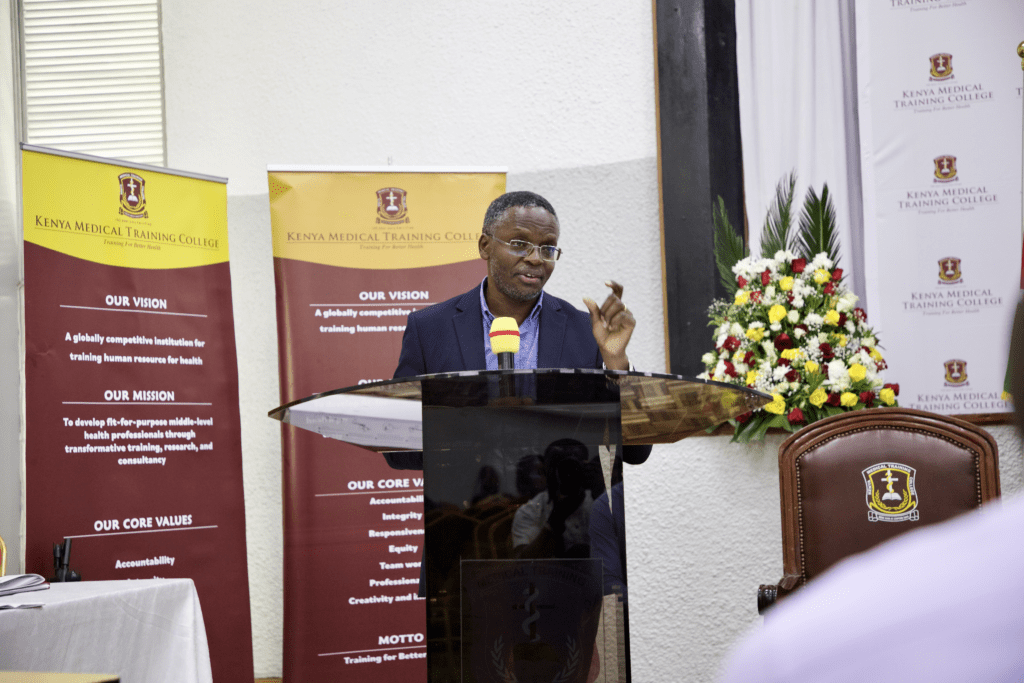
At the heart of the conference was a growing consensus: Kenya’s health system will only be as strong as the people who power it. In a keynote session on digital transformation in health education, Dr. Meshack Ndirangu, Country Director of Amref Health Africa in Kenya, challenged institutions to embed ethical, localised, and inclusive AI practices into their training ecosystems.
“With over 60 campuses and more than 40,000 students, KMTC’s potential to embed AI readiness and ethical digital health practices across Kenya’s health workforce is unmatched,” said Dr. Ndirangu. “The institution is uniquely positioned to lead Africa’s shift toward smarter, fairer, and community-responsive health systems, starting at the classroom level.”
He emphasised that while AI, machine learning, and predictive analytics are becoming central to global health systems, their impact in Kenya will hinge on how well they are adapted to local realities. “Tools that can’t operate offline, don’t support regional languages, or rely on foreign data will fall short in serving underserved communities,” he noted. True success, he argued, will require more than adoption, it will demand transformation that is rooted in context, equity, and inclusion.
That transformation is already underway. Through the Electronic Community Health Information System (eCHIS), community health promoters across Kenya are using digital tools to register households, track services, and improve referral outcomes. In Turkana, portable digital X-ray machines are enabling early TB diagnosis in hard-to-reach areas, redefining what frontline diagnostics can look like. AI-powered chatbots, such as those developed by Jacaranda Health, are providing pregnant women with life-saving, culturally relevant information directly on their phones.
These innovations are part of a broader shift led by Amref toward digitally enabled, community-led primary health care, a priority within its Strategic Plan 2023–2030. By investing in technology that strengthens human relationships, rather than replacing them, Amref is ensuring that digital tools serve both health workers and the people they care for.
Throughout his address, Dr. Ndirangu emphasised that AI is not a silver bullet, but a powerful enabler when applied responsibly. He highlighted how Amref and its partners, such as the Global Fund, Africa CDC and KEMSA, are already deploying AI tools to support disease outbreak detection, monitor oxygen plant performance, and guide response to malaria and cholera. These initiatives are reshaping public health surveillance and unlocking new levels of responsiveness across Kenya’s health system.
Yet with progress comes risk. Dr. Ndirangu cautioned that poorly governed digital systems, those built on foreign data, lacking transparency, or excluding marginalised groups, can do more harm than good.
“AI won’t fail Africa because of bad code,” he warned. “It will fail because of bad governance.”
To avoid this, he called for investments in infrastructure, ethical frameworks, and innovation ecosystems that empower local talent and frontline actors. KMTC, he argued, must play a pivotal role, not just as a training ground for tool users, but as a launchpad for tool builders, ethicists, and change agents.
As Kenya advances its Digital Economy Blueprint and National Artificial Intelligence Strategy, translating policy into impact will depend on institutions that train with purpose and partner for scale.
For Amref Health Africa in Kenya, this is not a future aspiration; it is a current commitment. Through digital innovation, policy advocacy, and frontline capacity building, Amref is working to ensure that no one is left behind in the evolution of health care.
As the KMTC conference came to a close, one thing became clear: Kenya’s digital health future will not be imported. It will be built locally by institutions that train ethically, lead boldly, and start where it matters most: in the classroom.
By Edna Mosiara – Ag Communications Manager