
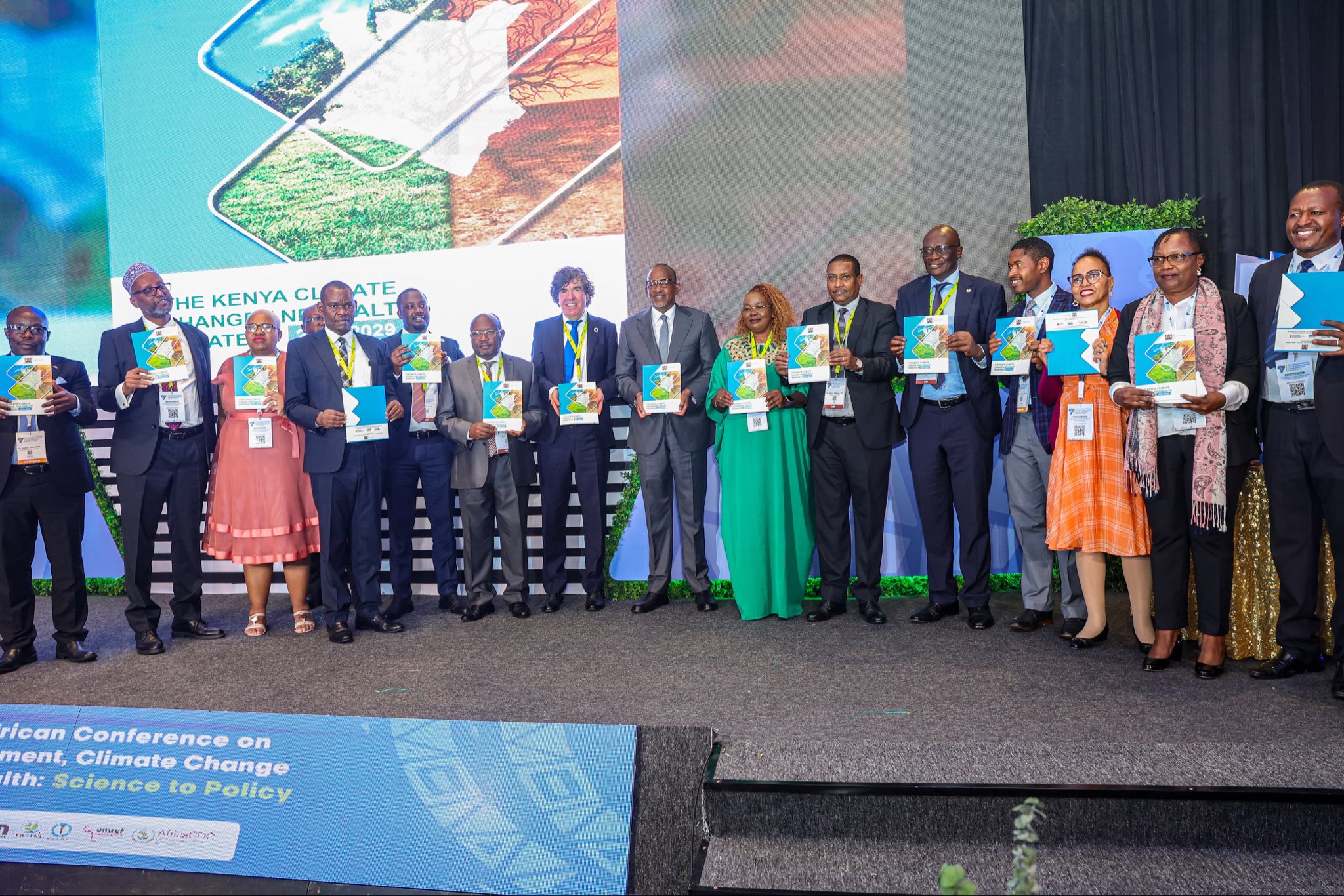
Nairobi, Kenya – The Pan-African Conference on Environment, Climate Change, and Health commenced in Nairobi, bringing together leaders, researchers, and policymakers to chart a new direction for Africa’s climate and health agenda. The four-day conference, themed “Harnessing Science, Policy and Partnerships for Environmental Sustainability and Climate Health Resilience,” offered a continental platform to translate scientific evidence into concrete policy actions that enhance climate-resilient health systems across Africa.
Kenya took a bold step forward during the opening session with the launch of two landmark policy frameworks: the Kenya Climate Change and Health Strategy (2024–2029) and the Kenya Household Air Pollution Prevention Strategy (2024–2029), unveiled by the Health Cabinet Secretary, Hon. Aden Duale. These strategies reaffirm Kenya’s leadership in integrating climate action into health and development planning, aligning with the country’s broader commitment to building a green, inclusive, and climate-resilient economy.
“It’s time to move beyond commitments and dialogue, to demonstrating impact. We must envisage a future where Africa’s climate–health successes are recognised as global solutions,” said Hon. Duale, emphasising the urgency of translating science into community impact.
Understanding the Climate–Health Context in Kenya
In Kenya, climate change trends and patterns are becoming more evident through an increased frequency and longer durations of extreme weather events, such as severe droughts, flooding, windstorms, landslides, and heatwaves – particularly in vulnerable communities and regions. These environmental changes have extensive health impacts, including the spread of climate-sensitive diseases, malnutrition, forced displacement, and interruptions to essential health services. The northern and north-eastern counties, the southern coastal tip, and the Rift Valley are increasingly prone to flash floods and extreme heat, while western, Nyanza, and coastal regions experience seasonal flooding.
The Kenya Climate Change and Health Strategy (2024–2029) addresses these challenges by providing a comprehensive plan to enhance health systems and increase community resilience. Led by the Ministry of Health, the strategy highlights the risks that climate change presents to public health, emphasises the need for adaptation and mitigation efforts, and encourages collaboration across sectors. It aligns with national legislation and international commitments such as the Climate Change Act (2016), the Health Act (2017), the Sustainable Development Goals (SDGs), and Kenya’s Bottom-Up Economic Transformation Agenda (BETA).
According to Principal Secretary Mary Muthoni Muriuki, State Department for Public Health and Professional Standards, “The strategy offers a clear direction for Kenya to protect its people from climate-induced health risks. By institutionalising climate action in health systems, we are safeguarding the future of communities who stand on the frontlines of the climate crisis.”
Leadership Through Collaboration and One Health
During his speech at the conference, Dr Martin Muchangi, Director of the Public Health and Environment Programme at Amref Health Africa, reflected on the interconnectedness of the environment, climate, health, and livelihoods – emphasising the need for deliberate, science-driven collaboration to foster transformative action.
Amref’s One Health approach links human, animal, and environmental health to address the root causes of disease and vulnerability. Climate change is no longer a distant threat but a lived reality for our communities. By combining science, leadership, and community-led action, we can turn this crisis into an opportunity for a healthier, more resilient Africa,” he said.
Dr Muchangi highlighted that the health sector can no longer operate in isolation. Incorporating environmental and social determinants of health into policy and practice, as seen in the new strategies, marks a significant shift in Kenya’s path towards sustainable, people-centred primary health care.
From Commitments to Action: The Nairobi Living Declaration
The opening of the conference culminated in the adoption of the Nairobi Living Declaration, strengthening Africa’s unified stance in global climate negotiations. The declaration outlines the continent’s shared priorities for equitable climate financing, inclusive technology transfer, and enhanced local research capacity, reaffirming Africa’s role as both a thought leader and a solutions hub in the climate–health nexus.
Convened by the National Environment Management Authority (NEMA), the Ministry of Health, the Ministry of Environment, Climate Change and Forestry, the Kenya Medical Research Institute (KEMRI), Amref Health Africa, the Africa Research and Impact Network (ARIN), the Africa Centres for Disease Control and Prevention (Africa CDC), and partners, the conference highlighted the significance of collaboration in developing evidence-based policies that genuinely benefit communities.
Building a Healthier, More Resilient Africa
As climate change continues to worsen, Kenya’s leadership, through the Kenya Climate Change and Health Strategy and the Household Air Pollution Prevention Strategy, signals a new era of proactive and coordinated climate-health action. These frameworks will guide national and county-level efforts, ensuring that policies deliver meaningful outcomes for vulnerable populations while promoting the One Health and planetary health agendas across Africa.
The Pan-African Conference on Environment, Climate Change, and Health marks a significant milestone, not only for Kenya but for the entire continent, reaffirming that the journey from science to policy must yield meaningful community impact.
Watch more here: Pan-African Climate–Health Conference 2025
Join the conversation: #ECHA2025