
“When they told me my son was underweight, I felt like a failure,” recalls 28-year-old Iman Salim. “I had been feeding him the best way I knew how. It felt like an attack on my motherhood.”
Iman’s story is one shared by many mothers in Mwaroni Community Unit (CU) in Ukunda, Kwale County. According to the Kenya Demographic and Health Survey (2022), 26% of children under five in Kwale County are stunted due to poor nutrition and hygiene. Left unaddressed, malnutrition limits children’s growth, weakens immunity, and threatens their future.
To tackle this challenge, Amref Health Africa, through the USAID Stawisha Pwani, is implementing the Positive Deviance/Hearth (PD/Hearth) approach, an innovative, community-led solution that empowers mothers to learn from each other, use locally available foods, and adopt healthier feeding and hygiene practices.
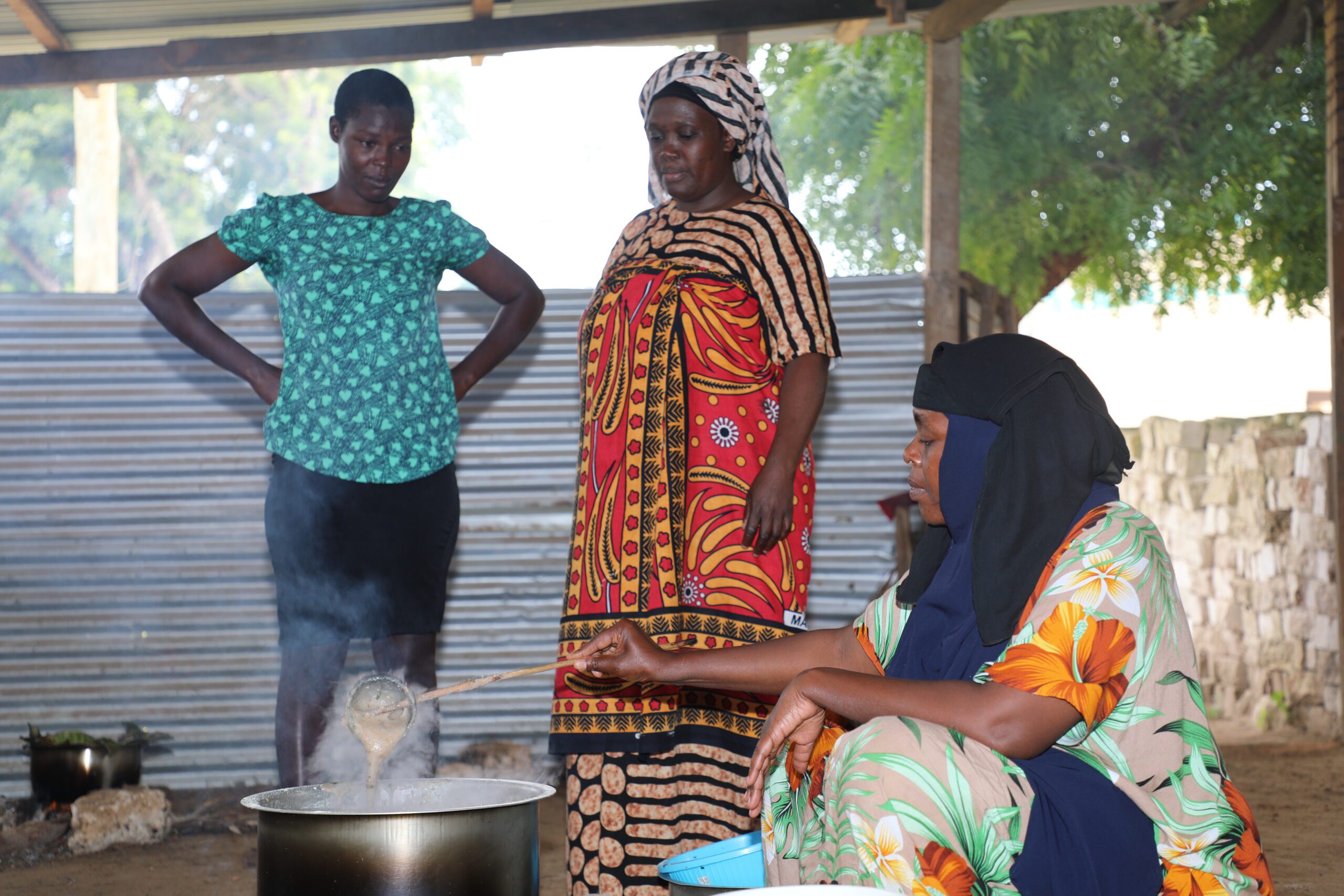
Every day for two weeks, fifteen mothers gather under the shade of baobab trees near a local mosque. Sitting on sisal mats, with their babies nearby, they prepare meals together, learn about hygiene, and share experiences. For Iman, this space has been life-changing.
“Here, I realized I wasn’t alone. Other mothers were going through the same struggle. Now, my son, Hassan eats better, plays more, and I feel hopeful again,” she says.
The sessions are led by Community Health Promoters (CHPs) like Bahati Juma, trained and supported by Amref. Bahati explains. “The program is integrated; we don’t just teach nutrition. We show mothers how to build tippy taps for handwashing, dish racks to keep utensils clean and air dry to prevent bacterial growth and even small kitchen gardens. For those without land, we demonstrate sack gardening. It’s about simple, sustainable solutions.”
Local Solutions, Sustainable Impact
Before each cycle, nutritionist Muchemudzo Kombo from Diani Health Centre surveys local markets to design an affordable menu. “The daily meal for 16 children costs just Ksh 325, about Ksh 20 per child,” she says. Mothers contribute Ksh 30 each day, purchasing maize flour, sardines, bananas, groundnuts, and greens, foods already familiar to the community.
This simple but powerful model is showing results. So far, 121 children enrolled have showed improved appetite and weight gain. Nationally, such programs contribute to reducing preventable child deaths and align with Kenya’s goal of meeting global nutrition targets and eliminate malnutrition entirely by 2030.
Children also benefit beyond nutrition. Group play before meals stimulates appetite and supports psychosocial development, reinforcing holistic child growth.
Building Resilience Beyond 14 Days
The PD/Hearth program runs for 14 days, but its impact is designed to last much longer. After the sessions, CHPs follow up first after 16 days and again at three months to ensure mothers continue the practices. Mother-to-mother support groups are also formed to provide peer encouragement and the women are encouraged to start income-generating activities (IGAs) to sustain their families.
As Muche explains:
“This program is about more than feeding children. It’s about building community resilience. We’re giving mothers the knowledge and skills to prevent malnutrition before it starts.”
Amref’s Strategic Impact
The USAID Stawisha Pwani is a 5-year program funded by the President’s Emergency Plan for AIDS Relief (PEPFAR) through the US Agency for International Development (USAID) to increase the use of quality county-led health services in four Coastal counties of Kilifi, Kwale, Mombasa and Taita-Taveta. The aim of the program is to strengthen county health systems with a focus on HIV Prevention & Treatment, Family Planning, Reproductive, Maternal, Child and Adolescent Health (FP/ RMNCAH) and Nutrition. The program supports the four county governments toward sustainability in quality and systems of health services
Through USAID Stawisha Pwani, Amref is advancing its 2023–2030 Strategic Plan by addressing social determinants of health; nutrition, hygiene, and livelihoods at the household level. By training CHPs, equipping facilities, and strengthening community networks, Amref is contributing to its organizational goal of building resilient primary health care systems.
This community-driven approach is proving that lasting health change doesn’t always require high-cost interventions. Sometimes, it begins with knowledge, a supportive community, and food prepared under the shade of a baobab tree.
Nyambura Gitonga, Communications and Advocacy, FRH Programme, Amref Kenya