
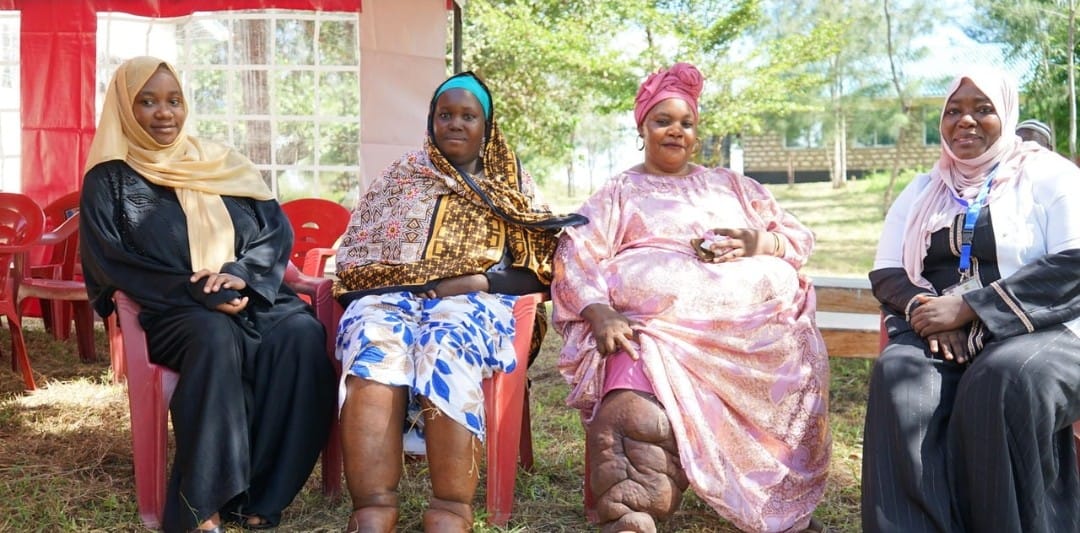
What you need to know:
- In Kenya, the disease is endemic in the coastal regions, which include Kilifi, Kwale, Mombasa, Taita Taveta, and Tana River counties.
The warm water mingles with vinegar as Mwanakame Nassoro carefully cleanses her feet, the sharp scent cutting through the morning air. It’s a ritual that has replaced years of hiding putrid wounds beneath long clothing, a daily act of self-care that once seemed impossible.
For 27 years, this simple morning routine was a nightmare. The 37-year-old mother would wake to the sight of grotesquely swollen legs, the smell of pus-filled wounds, and the crushing weight of a body that felt like a prison.
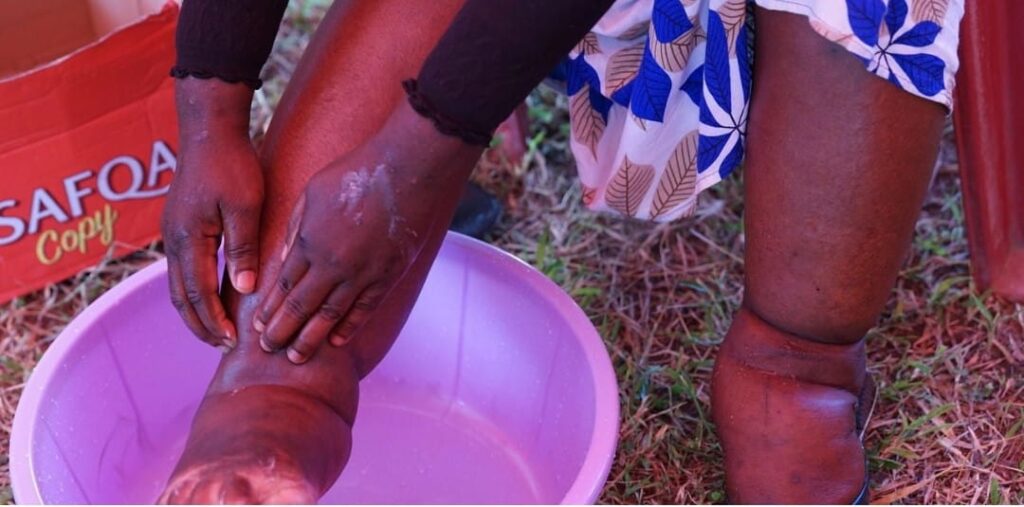
“I felt helpless and useless when I could no longer provide for my children,” Mwanakame recalls, her voice steady now but carrying the echo of years spent in darkness. “The pain became unbearable because my feet kept bulging, with pus oozing out from time to time, making it hard for me to go to work.”
Mwanakame’s ordeal began at age 10, when her legs first started swelling in her home in Kwale. What she didn’t know then was that she had contracted Lymphatic Filariasis (LF)—commonly known as elephantiasis—through the bite of an infected mosquito carrying parasitic worms.
Her parents, desperate for answers, turned to what they knew. “We travelled widely across Coast and Eastern regions and even into Tanzania—Dar-es-Salaam and other areas—for two years, but none of the witch doctors cured me,” she says.
The family’s search for a cure became a pilgrimage of desperation. When traditional healers failed, they pinned their hopes on a popular preacher known simply as ‘Prophet,’ famous for his supposed miraculous healing.
“I embarked on following him across various towns where he was holding crusades with the hope that I would receive a healing miracle, but after almost a year, I got tired and came back home,” Mwanakame tells Healthy Nation.
The hidden epidemic
What she didn’t realise was that she was fighting one of the world’s most neglected tropical diseases (NTDs). According to the World Health Organisation, lymphatic filariasis affects the lymphatic system—a network of vessels that drains excess fluid from tissues and returns it to the blood.
“The disease is characterised by asymptomatic infections in most cases, meaning many people with LF don’t show any external signs,” explains Dr Wyckliff Omondi, head of the Division of Vector Borne and NTDs at the Ministry of Health. “However, the disease can progress to cause severe swelling, particularly in the limbs and genitals, leading to permanent disability.”
The painful and profoundly disfiguring manifestations—lymphoedema, elephantiasis, and scrotal swelling—occur later in life, often after the damage to the lymphatic system has been silently progressing for years.
“In Kenya, the disease is endemic in the coastal regions, which include Kilifi, Kwale, Mombasa, Taita Taveta, and Tana River counties,” Dr Omondi notes, adding that Kenya is on the verge of eliminating elephantiasis by 2026.
The scale of the global burden is staggering. In 2023, 657 million people in 39 countries, including Kenya, were living in areas requiring preventive chemotherapy to stop the spread of infection.
The World Health Organisation (WHO) estimates that 25 million men suffer from hydrocele, whilst over 15 million people have lymphoedema.
A mother’s silent battle
Forty-year-old Amina Ali’s story began differently but followed a similar path of confusion and pain. At age 12, she started experiencing pains around her waist and lower abdomen—subtle symptoms that would persist for decades without explanation.
“Earlier this year, my children came from school and told me that they had been asked to tell older women about an ongoing free medical camp within the school premises,” Amina recalls.
The camp became her turning point. After years of silent suffering, medical presentations opened her eyes to the fact that what she had been battling was not only treatable but had a name.
“I was given four tablets and instructed to take them after having dinner that evening, with instructions to go back for a second dose of four tablets a few weeks later,” she explains. “When I woke up the following day, my body and feet felt much lighter to the point that I could walk properly.”
The transformation was immediate and profound. “After I completed my dose, I now feel as fit as a fiddle.”
When masculinity is under attack
For Saidi Mwacharo, the battle was even more personal. The 40-year-old had been silently enduring hydrocele—swelling in the scrotum—for 15 years, a condition that attacked not just his body but his sense of identity as a man.
“I have tried even looking for witch doctors because hydrocele completely alters your male functioning as a man, which means you cannot grant your spouse their conjugal rights,” Saidi reveals, his words heavy with the shame he carried for years.
His desperation led him down familiar paths of false hope.
“There was a witch doctor who demanded that I find him a red and white cock after which he would use his charms to make me have diarrhoea and be healed, but that never worked,” he discloses. “That was the fifth witch doctor who had lied to me despite the fact that I had spent thousands of shillings seeking their services after selling my land.”
The breakthrough
For all three, salvation came through an unlikely source: community health promoters (CHPs) making routine rounds in February this year. These grassroots health workers brought news of free medical camps organised by the county government in partnership with Amref Health Africa and the End Fund.
Despite doctors being on a nationwide strike at the time, the medical camps successfully provided essential tests and treatment to community members.
For Mwanakame, the diagnosis was a revelation. “This opened my eyes to what had actually been happening to my legs and the fact that no one had bewitched me,” she says. After treatment, her condition improved significantly.
Her daily routine has transformed from hiding wounds to empowered self-management. “Every morning I get a bucket full of clean water and a bar of soap to wash my legs, as well as vinegar as an antiseptic because it’s readily available and affordable compared to potassium permanganate. The doctor told me to put 250ml of vinegar in every 20 litres of water,” she explains as she demonstrates her morning care routine.
For Saidi, the solution was surgical.
“The CHPs took me to Zivani Dispensary. Later, I was taken to Kwale Sub-County Hospital for surgery in the genital area on March 9 and was discharged after two days of observation.”
The relief in his voice is unmistakable: “My manhood is intact, and I have recovered fully, thanks to doctors and modern medical treatment.”
The impact extends beyond individual healing. Mwanakame has joined a support group for people living with LF and is training to help others battling the same disease. “The community health promoter saved my life,” she says. “Knowing you are not alone makes things a bit easier.”
Salim Mwachondo, the nurse-in-charge at Zivani Dispensary, emphasises the importance of reaching out to those suffering in silence.
“When I got wind of Saidi’s plight, I immediately dispatched two CHPs to track him down and let him know that what he had been battling for years was treatable. I wish to thank CHPs for the incredible work they are doing to reach last-mile patients in places that are not easy to access.”
The road to elimination
The fight against lymphatic filariasis in Kenya has made significant progress. Dr Omondi explains that in 2015, the government embarked on continuous treatment of patients in 23 of the 26 endemic sub-counties in the coastal region. Treatment has now stopped in seven sub-counties—three where therapy was previously carried out, as well as in Bura, Galole, Garsen, and Taveta, where elimination of LF has been confirmed.
“Last year we embarked on what we thought would be the last mass drug administration, but due to logistical challenges like the unavailability of medicines, we were compelled to stop, which means this year we have to conduct MDA in 20 sub-counties,” Dr Omondi explains.
The broader context is sobering. According to End Fund Board chair and philanthropist Tsitsi Masiyiwa, NTDs affect more than 1.7 billion people worldwide, with more than 40 per cent of the global NTD burden concentrated in Africa. “I am dedicated to championing the importance of African leaders owning and leading the agenda on addressing the NTD disease burden, which according to WHO costs African economies billions of dollars every year in lost revenue,” the Zimbabwean philanthropist explains during her visit to Kwale.
“I am grateful for the collaboration with both the national and county government as well as Amref Health Africa. What started off as an idea is now fruitful work that we are proud of.”
Signs of progress
There are encouraging signs. Kwale Deputy Governor Josephat Kombo reveals that in the latest medical tests conducted by Amref doctors on 250 children in Kwale, no child tested positive for LF. “I have also seen LF patients make use of locally available antifungal solutions such as neem trees and coconut trees for ointment, which is impressive,” he notes. However, challenges remain, particularly in the arid and semi-arid parts of Kwale.
“From what our health experts have established, mosquitoes tend to be very active in places that are hotter within Kwale, and so climate change fuels the cases,” the deputy governor explains. “We have now been able to map out NTD cases in our county, but we need to appreciate that the biggest burden we grapple with is the cost of treating these patients.”
“We are, however, grateful for the support we have received from End Fund to train health workers as well as the support from the Health ministry through the Universal Health Coverage programme.
A future free from chains
As a new day dawns, Mwanakame completes her daily care routine—a ritual that now represents hope rather than despair. Her legs, once sources of shame and pain, are healing. The putrid smell has been replaced by the clean scent of vinegar and soap.
“The ministry observes that acute episodes of local inflammation involving skin, lymph nodes, kidney, and lymphatic vessels often accompany LF,” Dr Omondi explains.
“Most are the result of secondary bacterial skin infection where normal defences have been partially lost due to underlying lymphatic damage. These acute attacks are debilitating, may last for weeks, and are the primary cause of lost wages among people suffering with LF.”
But for Mwanakame, Amina, and Saidi, those days of lost wages and lost hope are behind them. Their stories represent not just personal triumphs but a glimpse of what’s possible when proper healthcare reaches the most neglected communities. “People affected by LF are not only physically disabled but suffer mental, social, and financial losses, contributing to stigma and poverty,” the WHO notes. Yet these three transformed lives speak to the power of accessible healthcare and community support.
Article first published on https://nation.africa/kenya/health/from-witch-doctors-to-modern-medicine-breaking-the-chains-of-elephantiasis-5100952