

The Thika sun bears down hard, the kind that sinks into your skin like heat into wood. But it does little to slow down Grace Wangechi and her colleagues as they move through the neighbourhood, knapsacks on their backs and carrier bags in their arms, pesticides in tow.
Grace is a Community Health Promoter (CHP) with the Blue-Ribbon Community Health Unit in Kiambu County, one of the frontline workers Amref Health Africa has been supporting through the Africa Health Collaborative Programme, funded by the Mastercard Foundation. The programme works to strengthen Primary Health Care by building the capacity, tools, and economic agency of community health workers like her. One way it does this is through Health Entrepreneurship (HENT) training, which equips CHPs to identify income-generating opportunities within the communities they already serve. To date, the programme has supported HENT training for 10,127 CHPs across Machakos, Kiambu and Nairobi counties, reaching workers embedded in communities where the distance between a household and the nearest health facility makes the CHP’s role especially critical.
Grace’s group took that training seriously. During routine household visits checking on clients managing hypertension, diabetes, and other conditions, they kept noticing the same problem: pests. Cockroaches, in particular.
“We identified that the members of this unit faced a pest predicament within their homes,” Grace explains. “We saw this as an opportunity to make money in addition to the health services we offer.”
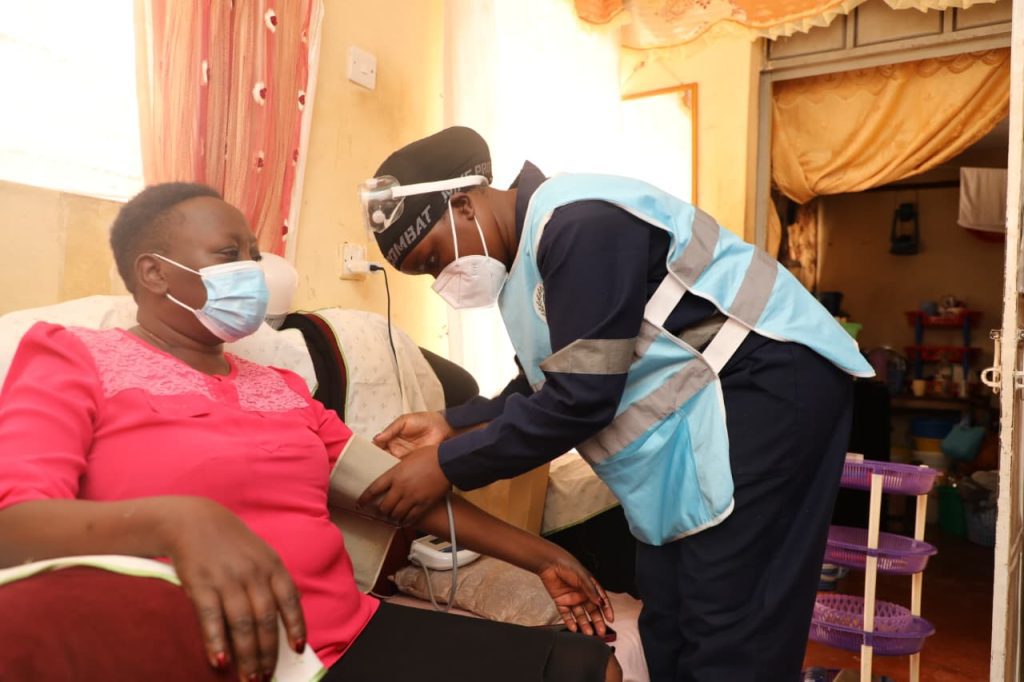
Today’s mission is Esther’s house. Esther is one of Grace’s regular clients, living with high blood pressure and renal disease. In the course of her routine visits, Grace noticed that the house needed fumigation. She arrives with both her health kit and her pest control supplies, and in true CHP fashion, pulls her CHP uniform over her work apron before getting started.
First things first, though. She takes Esther’s blood pressure, records it, checks in on how she’s been managing. Only then does she move on to the fumigation. The sequencing matters to her.
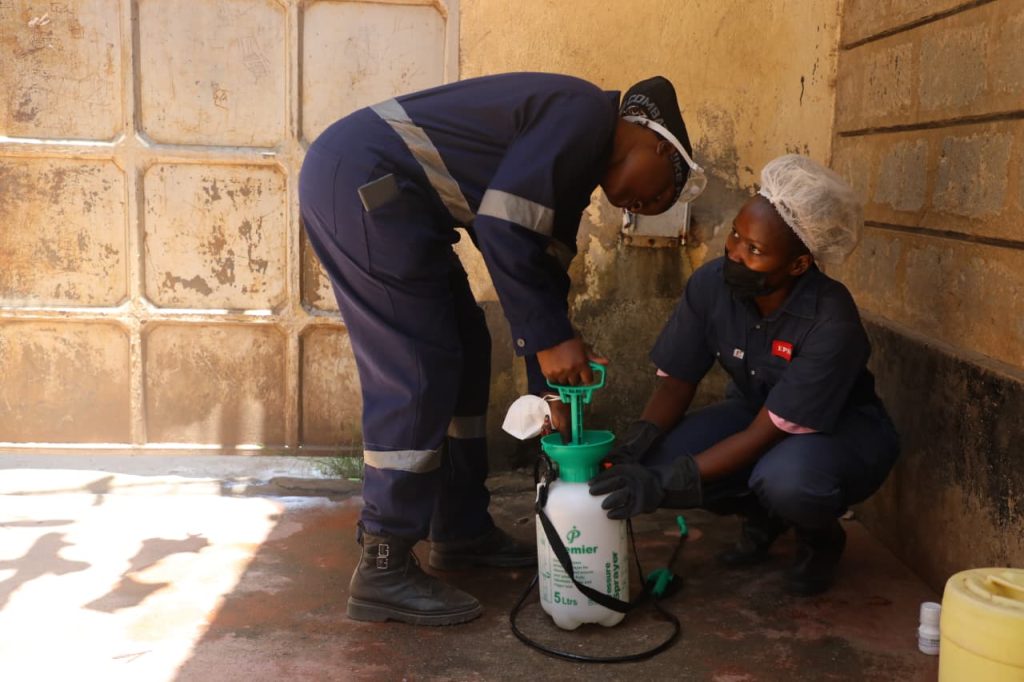
Once she’s done, she steps outside and calls over the neighbours. “These roaches lay eggs as they go,” she tells them, demonstrating the spray gun. “The benefit of using this equipment is that it kills not just the roaches, but the eggs too, so they won’t hatch and the infestation doesn’t continue.” The neighbours nod, following along closely.
For their fumigation services, Grace and her team charge 800 shillings per household. It’s a modest but meaningful sum that complements the Ksh 5,000 monthly stipend they receive from the national and Kiambu county governments.
“Ever since we began, I have been able to support my children with the extra income,” Grace says. “I am grateful to Amref for the HENT training. It helped us see what we already had, access to people’s homes, their trust, and knowledge of their needs as something we could build on.”
That is precisely what the Africa Health Collaborative Programme is designed to do. By embedding livelihood skills into the work of PHC workers, the programme moves beyond a model where CHPs are purely service delivery agents and positions them instead as community-rooted entrepreneurs, people with both the health knowledge and the economic tools to sustain themselves and their families. When CHPs are more financially stable, they stay. When they stay, continuity of care improves. And when communities trust the person showing up at their door, health outcomes follow.
This work sits squarely within the vision of the Mastercard Foundation’s Young Africa Works strategy, which sets an ambitious goal of enabling 30 million young people across Africa especially young women to access dignified and fulfilling work by 2030. Central to the strategy is a commitment to engage and empower young women as transformational leaders, bolster education and training systems, and support African institutions to advance change in their own countries.
Grace and her colleagues are a direct expression of that vision young women who entered the workforce as community health workers and, through targeted training and institutional support, have become entrepreneurs driving economic activity at the household level. Their work is neither purely health nor purely economic; it is both, which is exactly the kind of integrated, dignified livelihood the strategy envisions.
For Grace, it’s simpler than all that. “These are my people,” she says, packing up her bag. “I want them to be well. And I want to be okay too.”
Author: Nyambura Gitonga, Communications Officer, FRH, programme, Amref Health Africa in Kenya