
For years, health workers in Nakuru County relied on delayed reports and incomplete records to plan services for thousands of families. Nurses often discovered critical gaps too late; mothers missed essential screenings without knowing, and households in remote villages went months without follow-up.
Ancillah Monari, a Community Health Strategy Lead in Njoro Sub-County, remembers when her team struggled to understand why teenage pregnancies were rising in the area. The problem felt scattered and overwhelming, with no clear starting point. Everything changed when she accessed the sub-county’s digital dashboard and saw the situation with new clarity. The data highlighted the exact villages where cases were concentrated—including communities that had not been receiving enough youth engagement.
“We could finally see where the problem was coming from,” she recalls. “Once we understood the pattern, we designed targeted youth dialogues. Within months, the rate dropped from 32% to 17%.”
Across the county, Roselyn Wangari Mungai, a Nakuru County Executive Committee Member for Health, has watched digital dashboards redefine how health emergencies and routine services are handled. She recalls the tense days when Nakuru reported its first mpox cases. In the past, such moments often meant uncertainty and slow coordination. This time, however, the data told the story in real time, where cases were emerging, which contacts needed monitoring, and where immediate interventions were required. “Because the data was clear and timely, we contained the outbreak quickly,” Roselyn says. “It allowed us to act before the situation could escalate.”
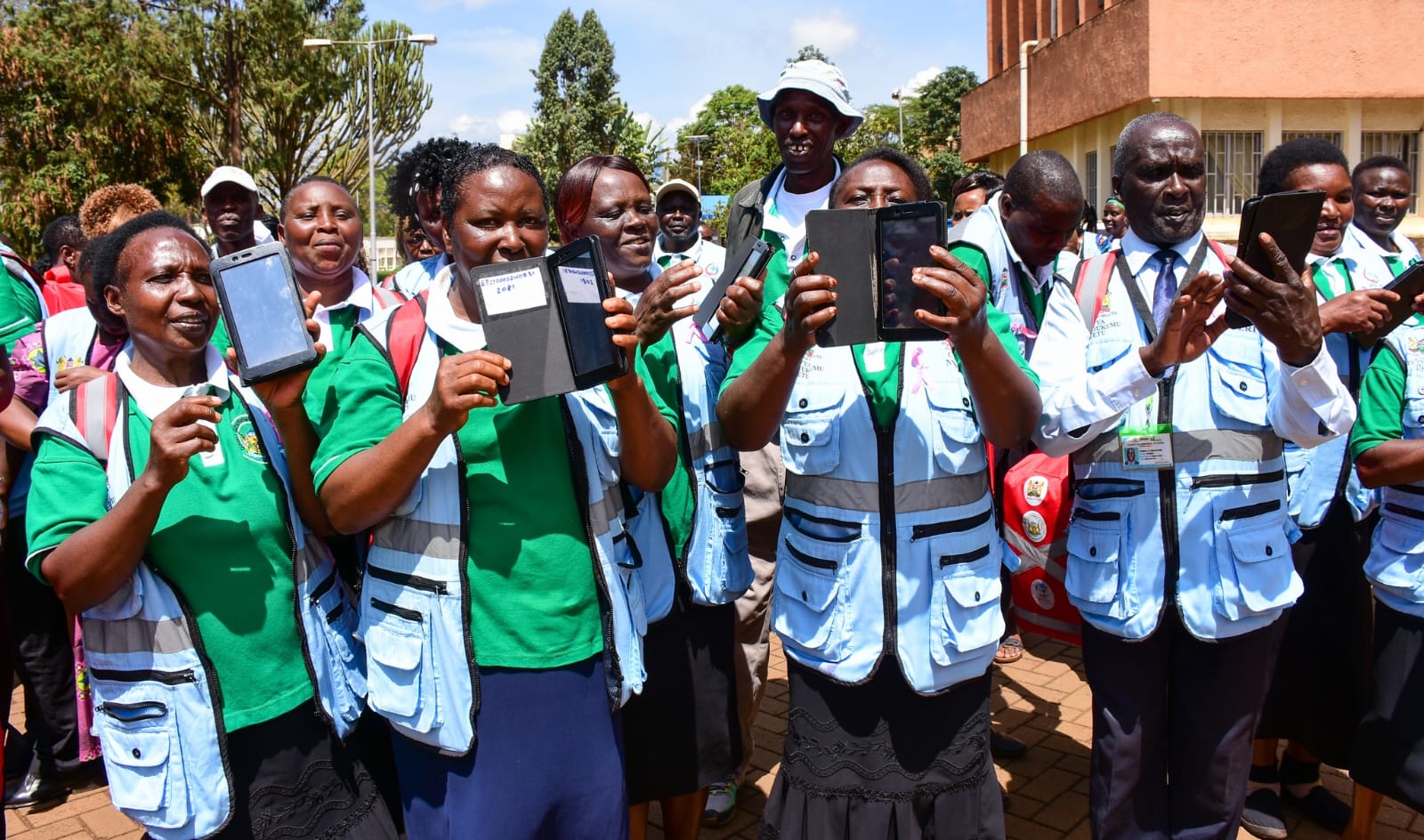
These dashboards, which integrate information from (eCHIS) Electronic Community Health Information System and (KHIS) Kenya Health Information System, have become everyday tools for frontline teams in Gilgil, and Njoro sub-counties Instead of waiting weeks for reports, health workers now know instantly which households have missed hypertension screenings, where maternal health indicators are falling, or which communities require urgent engagement. In Kiptangwanyi Health centre, this means the Primary Care Network can deploy its 308 Community Health Promoters the moment the dashboard reveals a service gap. Families in remote villages, once missed simply because no one knew, now receive care exactly when they need it.
The changes are equally significant in Njoro, where Mau-Narok Health Centre serves more than 25,000 residents. The team can observe, week by week, how many household visits have been completed, whether non-communicable diseases (NCDs) have been addressed, and which villages still require outreach. This has resulted in 42 integrated outreach initiatives, 34 community dialogues, and an increase in the early detection of hypertension and diabetes. Health workers state that, for the first time, planning feels coordinated instead of reactive. “We no longer guess,” one nurse explained. “The dashboard tells us where to go.”
The impact runs deeper than service numbers. Health workers report that the more precisely they can plan, the stronger their relationships with communities become. Support groups for non-communicable diseases (NCDs) and mental health have gained new momentum because the people who need them most are identified earlier. Facilities have shortened waiting times, improved service flow, and made community members part of the decision-making through scorecards and review meetings. More than 35,924 people across Gilgil and Njoro sub-counties have already been reached through integrated outreaches guided by these real-time insights.
This digital shift has also brought new confidence to county-wide health coordination. Roselyn notes that accountability has improved; teamwork between community and facility staff is stronger, and decisions that once took days now take minutes. She sees dashboards not just as tools but as a new language of leadership, one grounded in evidence rather than assumption.
Behind these changes is the Transforming Community Health Through Integrated Primary Care (THRIVE) initiative, implemented by Amref Health Africa in partnership with the County Government of Nakuru. By equipping teams with digital tools, strengthening data skills, and supporting Primary Care Networks, the partnership has enabled people like Ancillah and Roselyn to turn information into action, and action into impact.
From the plains of Gilgil to the highlands of Mau-Narok, Nakuru County is moving from a reactive to a proactive health system, where every decision is informed, every outreach is targeted, and every household has a better chance of receiving the care it needs.
About Project Thrive
Project THRIVE is a transformative three-year (2024– 2026) initiative reimagining PHC in Kenya, with active implementation in Nakuru and Nyeri counties. By investing in health workers, empowering communities, and harnessing data systems such as KHIS and eCHIS, the project is building resilient, gender-responsive PHC models that deliver real impact in partnership with Moderna Charitable Foundation.
Author: Michelle Julie Atieno – Communications Intern, Amref Health Africa