
What does it take to bring lasting health change to communities battling malaria every single day? For Amref Health Africa, the answer is simple but powerful, equip and empower the people who live there.
Thanks to support from the Global Fund Malaria Grant Cycle 7 (GC7) and a strong partnership with the Ministry of Health, Amref is helping translate Kenya’s Malaria Strategy 2023–2027 into real-world action. The goal? To reduce malaria cases by 80% and deaths by 90% by 2027. And that vision starts where the battle is most urgent, at the community level, with Community Health Promoters (CHPs) leading the change.
Since 2012, Amref has been working with the Ministry of Health to scale up community-based malaria interventions. Today, up to 22,870 CHPs have been trained and equipped through the Community Case Management of Malaria (CCMm) approach, bringing lifesaving care directly to homes, schools, and workplaces. Over 2,287 Community Health Units (CHUs) are now active in 12 counties, an increase from 1,933 CHUs supported by trained Community Health Assistants (CHAs) and Community Health Extension Workers (CHEWs). Each CHP is responsible for up to 500 people, meaning approximately 11.4 million Kenyans can now access prompt malaria care closer to home.
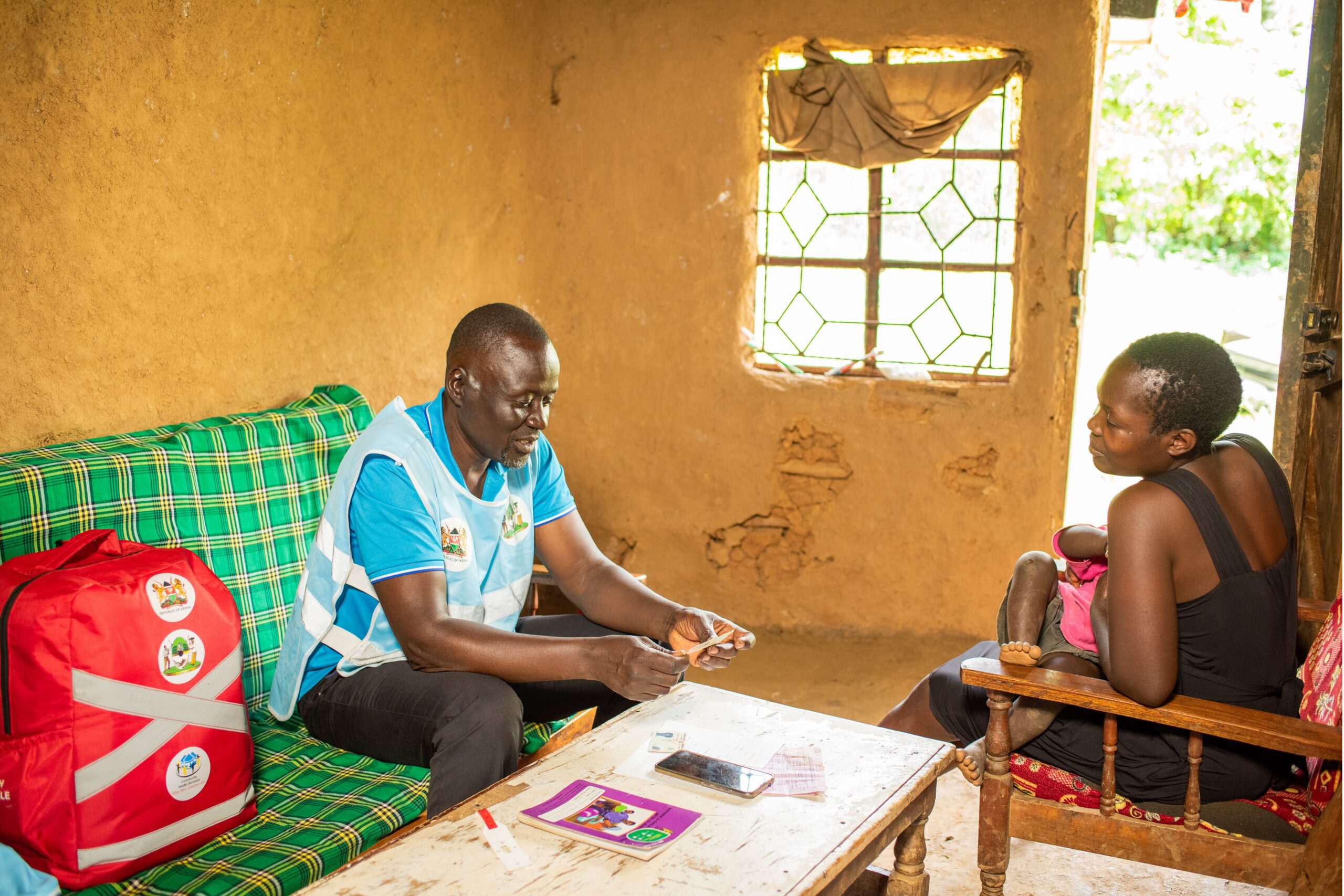
In remote villages and underserved urban settlements where health facilities are hard to reach, CHPs are closing the gap. They’re not just trained health workers, they’re trusted neighbours who deliver care, build trust, and provide education with every household visit.
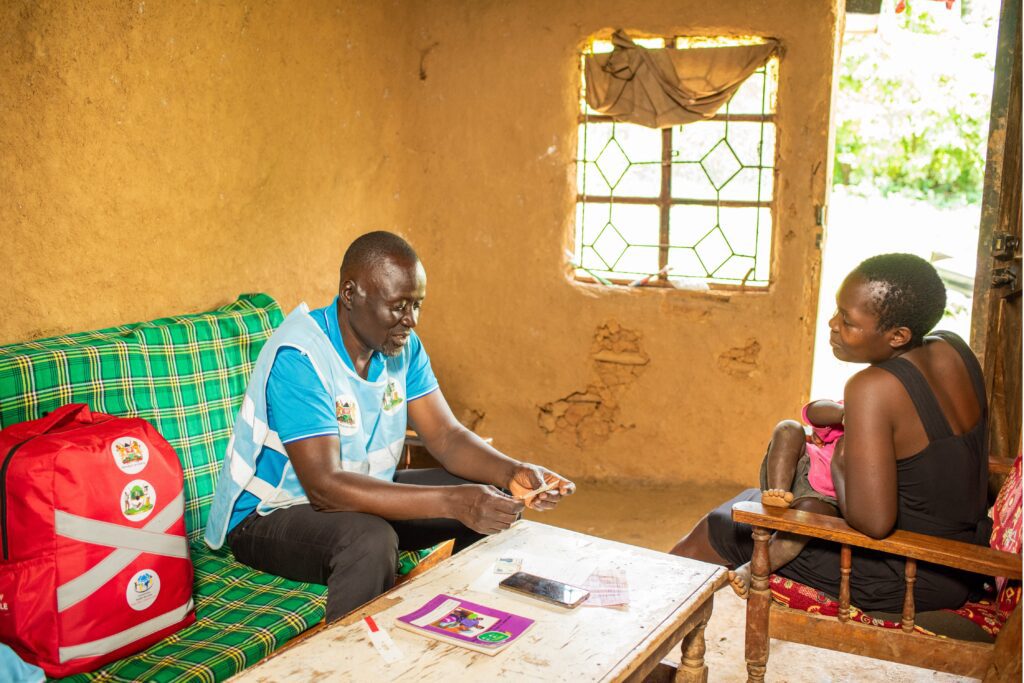
Meet Jacob Miheso (Left), a dedicated Community Health Promoter tending to a household in his catchment area. His journey began with a simple yet powerful observation watching his community struggle with preventable health issues. When the government introduced the community health worker program, Jacob heard about it through a local Baraza. He saw more than just an opportunity; he saw a calling. Eager to gain knowledge and make a difference, he stepped forward and embraced the role. Today, Jacob is not just a health worker, he’s a lifeline for his community, bringing care, hope, and lasting change where it matters most.
CHPs are also tackling one of malaria’s deadliest challenges, its toll on pregnant women and young children. In high-burden areas like the Lake endemic zone, where malaria prevalence stood at 19% (2020 Kenya Malaria Indicator Survey), these efforts are especially critical. CHPs are now central in ensuring pregnant mothers attend antenatal care, access intermittent preventive treatment in pregnancy (IPTp), correctly & consistently use LLIN and receive consistent follow-up, contributing to healthier outcomes for both mothers and their babies. Children, too, benefit from timely malaria management, thanks to the door-to-door presence of these community heroes.
To power this progress, Amref is helping Kenya’s health workforce keep pace with digital transformation. In collaboration with the Ministry of Health’s Division of Community Health, Amref supported the roll-out of electronic Community Health Information System (eCHIS), enabling CHAs, CHEWs, and CHPs to collect and report real-time data for better decision-making.
Digital tools like M-Jali and Jibu are transforming how services are delivered. Jibu offers online certificate-based training to build health workers’ skills, while M-Jali supports data collection and analysis, including from private sector partners such as retail pharmacies. With paper forms on the way out, Kenya’s health system is becoming more accurate, efficient, and transparent.
But malaria prevention doesn’t stop at community health units. Amref is actively supporting schools, school health clubs, and civil society groups to take part in this community-first approach. With engaging activities like malaria quizzes and advocacy events, we’re empowering children and youth to become powerful messengers for malaria awareness.
CHPs continue to walk shoulder-to-shoulder with their communities educating families on malaria prevention, symptom recognition, care seeking and treatment adherence. Their message is clear and consistent, and it’s sticking! No fever should go unchecked, no child untreated, and no life lost.
At the heart of this national effort lies a robust Monitoring & Evaluation (M&E) system that ensures CHPs are supported, resources are well-utilized, and measurable impact is achieved. Through platforms like eCHIS and M-Jali, data is no longer just a record, it’s a tool for strategy, impact, and equity. Community reports are captured at CHU level through link health facilities to the national repository, KHIS. The contribution of CHPs in number of cases identified, managed, referred and followed up provide essential denominators in tracking population-based health indicators. Healthcare performance therefore is closely monitored from the community.

This dashboard reflects the vital role of Community Health Promoters (CHPs) in Kenya’s malaria response. In just one year, CHPs confirmed over 784,000 malaria cases through community-based care a testament to their reach, trust, and effectiveness. Each bar on this chart represents not just cases, but lives touched by these local health heroes.
And what truly sets this approach apart is the human connection. Amref is not just counting numbers, it’s listening. It’s ensuring that everyone from pregnant adolescents to people with disabilities and migrant families is included in the fight against malaria.
Yet, even the most well-designed systems face headwinds. Recent funding uncertainties have strained Kenya’s health sector, disrupting critical programs. These challenges are a powerful reminder of the need for strong, community-rooted health systems that can weather any storm. In this context, CHPs have proven to be the steady hands holding the line, ensuring essential care reaches every home. Their unwavering dedication reflects the strength of local leadership in advancing public health, even amidst broader disruptions. So, the next time a CHP knocks on your door, remember, they’re not just checking in on your health, they’re carrying a national dream on their shoulders, a dream of a malaria-free Kenya.
And that, right there, is what real, lasting health change looks like.