

In the schools of western Kenya, a five-year public health intervention has yielded a significant yet complex result. A powerful combination of drugs and clean water has nearly eliminated one ancient scourge, yet has left another to persist in stubborn pockets. The findings are reshaping how scientists think about defeating parasitic diseases for good.
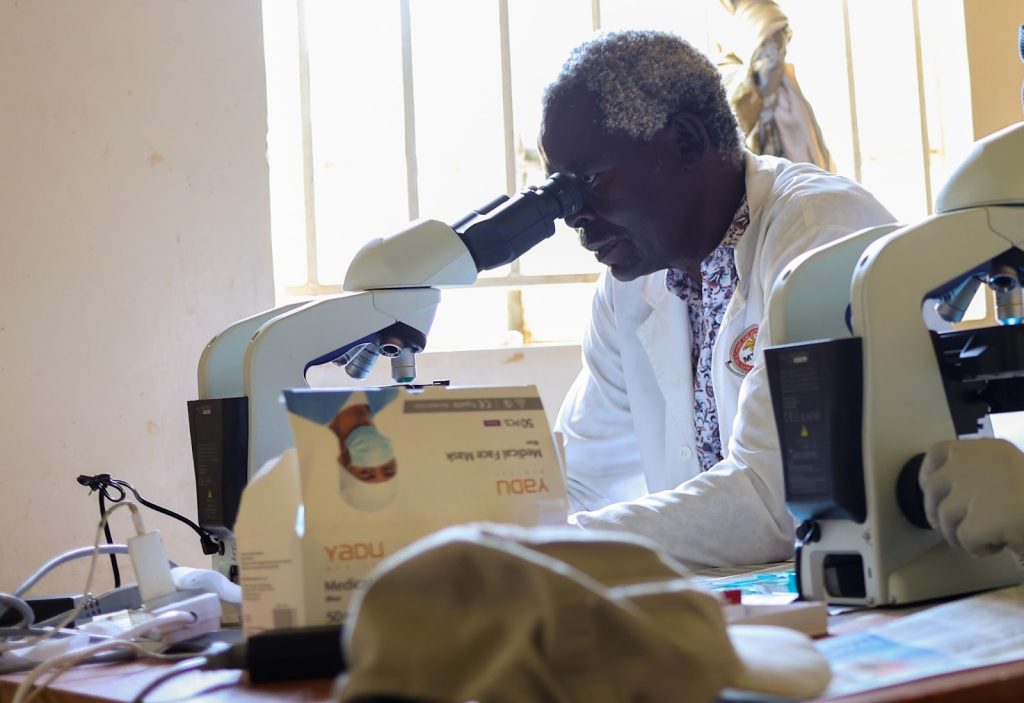
In the cramped but orderly makeshift classroom, research assistants and pupils work concurrently at Malava Primary School in Kakamega County. Bellamy, a seasoned research assistant, peers into small, transparent and barcoded stool samples received from the pupils. On the slide before him is a smear of stool from a 10-year-old boy. It’s a routine sample, one of thousands being collected across four western Kenya counties this week for the deworming innovation fund’s impact assessment survey. For Bellamy and the team from Amref Health Africa, the Children’s Investment Fund Foundation (CIFF), the END Fund, and the Kenya National Public Health Institute (NPHI), this small sample is a piece of a much larger puzzle.
This is the endline survey—the final act of a five-year, high-stakes impact assessment to measure the impact of one of the most comprehensive deworming campaigns ever mounted in the region: the Deworming Innovation Fund.
Between 2021 and 2025, a coalition of partners implemented a multi-pronged intervention across Bungoma, Kakamega, Vihiga, and Trans Nzoia counties. The strategies included regular rounds of Mass Drug Administration (MDA) to treat entire communities, coupled with intensive “WASH” (Water, Sanitation, and Hygiene) interventions and social and behaviour change communication. School children were not just given pills; they were taught about hygiene through innovative video puppetry and sensitization programs while WASH techniques improved access to clean water and toilets. The goal was to break the transmission cycle of two families of parasites that have plagued these communities for generations: Soil-Transmitted Helminths (STH), commonly known as intestinal worms and locally referred to as minyoo, and schistosomiasis (SCH), commonly known as bilharzia.
Now, as the team visits the same 72 schools they first mapped in 2021, the data is delivering a powerful, two-part verdict: a remarkable victory, and a stubborn puzzle.
“A Phenomenal Victory” Against Bilharzia
When the results from the Kato-Katz diagnostic method — the gold-standard microscopy method used by Anthony Wekesa, a Medical Parasitologist, and his colleagues, were compiled, the impact on bilharzia was undeniable.
“The reduction in Schistosoma mansoni was phenomenal,” says Dr. Odiere, a leading expert on the surveys. Across all the wards targeted for MDA, the prevalence of bilharzia plummeted by nearly 90%, from an average baseline prevalence in high‑burden areas to just 1.3%. The most morbid, heavy-intensity infections, which cause the severest organ damage, were driven to zero. Bilharzia is acquired through contact with contaminated water. MDA effectively clears the adult worms from the human host, and because water contact is often focused in specific locations, the chance of rapid re-infection, while present, is lower than with STH.
Some counties achieved what once seemed impossible. For example, Bungoma slashed its prevalence by 97%, while Trans Nzoia significantly reduced prevalence and heavy intensity to 0%. For Robert Wetoto, Bungoma County’s Neglected Tropical Diseases (NTD) coordinator who has overseen the five-year journey, it was a moment of vindication. “It proves our strategy worked,” he says, reflecting on the countless rounds of door-to-door MDA and community mobilization. “It shows we can defeat these diseases.”
The success against bilharzia points to a clear conclusion: MDA, when consistently delivered and paired with basic health messaging, WASH, partnerships, coordination, and improved regular surveillance, is a devastatingly effective weapon against this particular parasite. It was evidence of what coordinated public health can achieve.
The Puzzle of the Persistent Worms
But the story of the intestinal worms is far more complex. When the team analyzed the data for combined STH, the results were sobering. Overall prevalence barely budged, inching down from 8.1% to 6.8% — a statistically significant but puzzling 16% reduction.
This aggregate figure, however, masked a deeply concerning reality on the ground. The performance varied wildly from county to county. While Trans Nzoia managed to cut its worm burden by more than half, Vihiga County saw its infection rates actually increase, rising from 10.7% to 15.8%, driven largely by a surge in roundworm and whipworm. Vihiga also experienced an uptick in bilharzia prevalence, which climbed from 1.7% to 2.5%.
Unlike bilharzia, STH is transmitted through fecal contamination of soil. For example, a single open defecation site near a school kitchen or a shaded play area can contaminate the environment for months, as eggs require time to mature in the soil before becoming infectious. This makes STH transmission intensely local and dependent on sanitation behaviors.
To understand this paradox, the team had to look beyond the county-level averages and zoom in on the individual schools. When they did, the picture became clear. They weren’t facing a uniform problem, but a series of stubborn hot spots.
“The overall mean infection intensity masks a highly polarized distribution,” explains Amref’s Data Analyst Dollycate Njagi. “A small subset of schools is driving the numbers.”
Schools like Chesiro Primary, where more than half of the children still harbor worms, have emerged as persistent reservoirs of transmission. So too has Maganyi, which maintained prevalence at roughly the same level between baseline and endline, as well as Ebusyubi and Shitaho, where infection rates, though still high, had actually declined since the start of the campaign. These are the places where the infection is holding on, quietly thriving despite the county-wide efforts.
The “Hotspot” Hypothesis is A New Frontier
Why did the drugs work so well against bilharzia but fail to dislodge intestinal worms from these specific pockets? The answer, researchers believe, lies in the fundamental biology of the parasites and the nature of their transmission.
Unlike bilharzia, which is contracted through contact with contaminated water, minyoo or intestinal worms are spread through contact with contaminated soil. This makes its transmission cycle far more dependent on the immediate environment. A broken well, a single household without a latrine, a play area shaded by fruit trees where children eat the mangoes and, without nearby latrines, may defecate nearby, creating ideal conditions for transmission even when a whole county is being treated.
“What this survey has given us is a high‑resolution picture of the problem,” says Chitiavi Juma, NTDs Manager at Amref Health Africa. “We now know that a blanket approach is not enough. We need a precision strike.” This means shifting from annual to biannual Mass Drug Administrations in hotspots, targeting school-aged children (SACs) who are the primary carriers, while pairing treatment with targeted WASH infrastructure audits at the household level to root out the open defecation sites that fuel reinfection. This is the “Hotspot Hypothesis.” The future of intestinal worms control, the data suggests, lies not in wider nets, but in targeted, intensive interventions. The next phase, beyond treating, is about identifying schools like Chesiro, understanding why they are hotspots, and investing in targeted treatment and messaging.
In taking the next step, there is a need to follow the children from the classroom to their homes. “We need to see their backgrounds, their behaviours; household surveys in high burden schools,” Wetoto says, as he examines the numbers. “Do they have clean water? Do they have a toilet at home? That is where the real story is for us to accurately identify exact transmission drivers.”
Drafted by Faith Kathambi Mutegi NTDs Knowledge Management Officer, Chitiavi Juma NTDs Program Manager and Dollycate Njagi NTDs Data Analyst.
Edited by: Paulette Adhiambo, Communications Associate, Amref Health Africa