In a region where health workers often carry the weight of entire communities on their shoulders, a new generation of leaders is stepping forward.
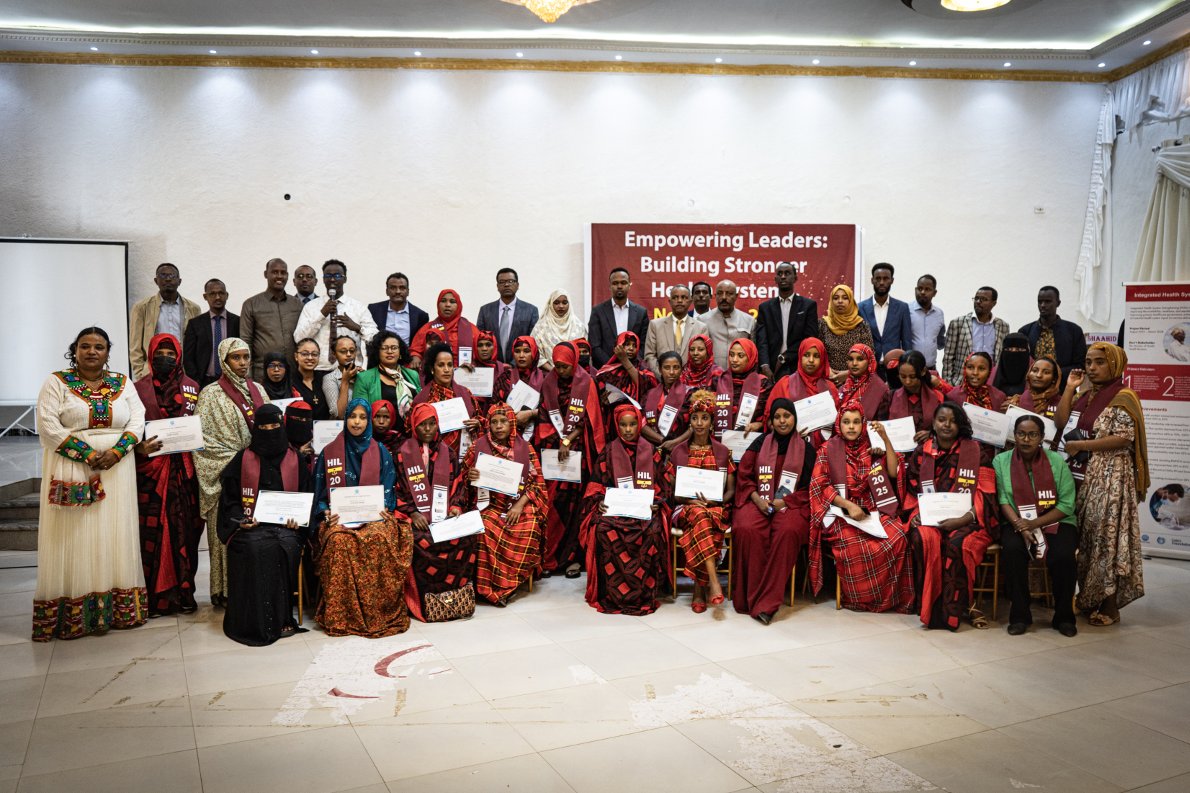
On 26 November 2025, in Jigjiga, Somali Region, 90 frontline and mid-level health professionals graduated from Ethiopia’s High Impact Leadership (HIL) programme—emerging not just as managers, but as problem-solvers, system shapers, and champions of community-centred care. Their graduation marks a powerful shift that leadership is no longer confined to offices, but is taking root in the hands of those closest to the people.
The event marked another milestone in a national effort to strengthen leadership within Ethiopia’s primary health care system. HIL trains health workers and woreda leaders to think and act as system stewards, equipped with practical skills in systems thinking, data-driven decision-making, adaptive leadership, and evidence-informed planning. To date, the programme has reached more than 500 health workers across 15 woredas in Afar, Amhara, Oromia, Sidama, and Somali regions through the Integrated Health System Strengthening (iHSS) project.
State Minister of Health H.E. Seharla Abdulahi encouraged graduates to apply their new skills to real health system challenges, emphasising the importance of emotional intelligence, community engagement, and cross-sector collaboration. “Leadership is not only about technical skills,” she said. “It is about knowing yourself, staying composed in difficult moments, and working closely with the communities you serve.”
A highlight of the ceremony was the presentation of selected capstone projects. Drawn from more than 180 initiatives, these projects showcased innovative solutions to local challenges in maternal and child health, health system strengthening, communicable and non-communicable diseases, and data quality. Many demonstrated strong potential for scale-up across additional health facilities and woredas.
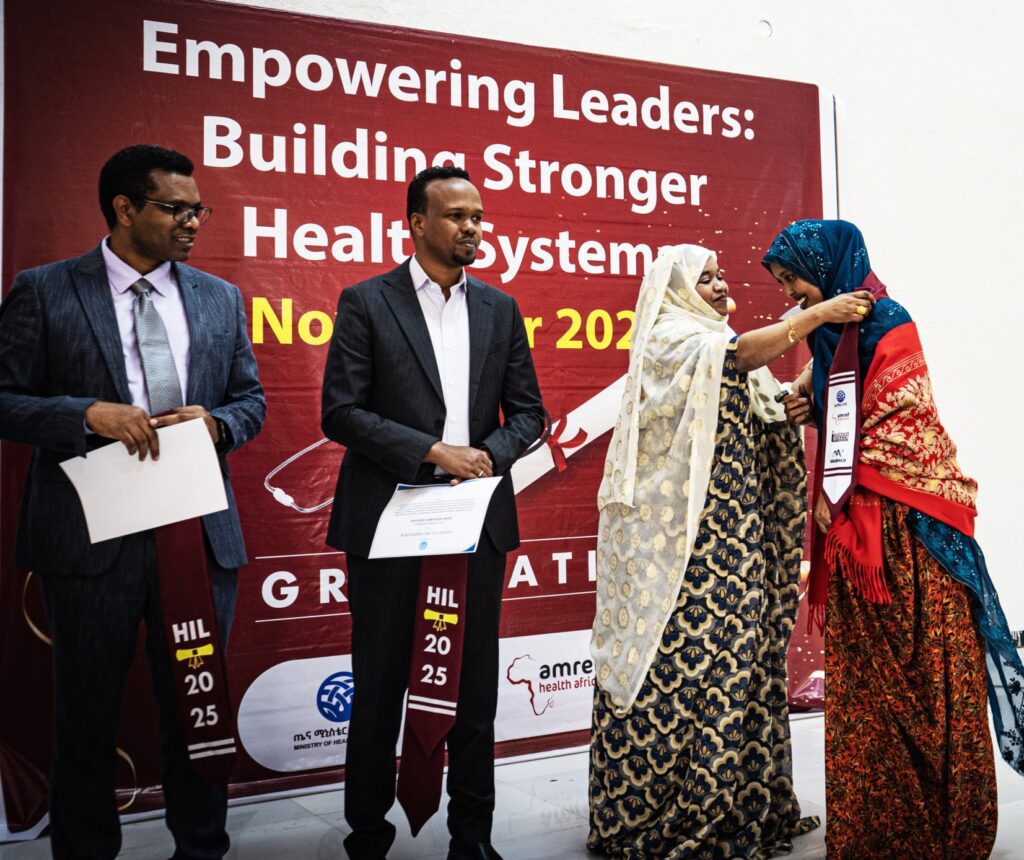
Addressing the graduates, Dr Musa Ahmed, Head of the Somali Regional Health Bureau, underscored the programme’s importance: “We need leaders who work tirelessly, who understand the weight of the responsibility on their shoulders and the vision we are striving for. In the past you were only service providers; today you stand as health leaders, leaders for your work, your teams and your communities. If each of you embraces this role, together with our partners we will move closer to a healthier Somali Region and become a true centre of excellence for quality health services.”
Speaking on behalf of Amref Health Africa, Dr Lisanu Tadesse, Technical Director for the Integrated Health System Strengthening Project noted, “As we move to expand iHSS to 50 districts, we have seen that strong leadership and governance in primary health care are high-impact system interventions, closely linked to facility readiness and better service utilisation. This training package is part of the effort to build strong system. Amref Health Africa in Ethiopia will continue working with the Ministry of Health and Regional Health Bureaus to scale up high-impact health system interventions, including HIL, to strengthen subnational health systems.”
Representatives from Amref’s sub-grantees, EPHA and MaMeLa, Dr Alemayehu and Dr Kalkidan, respectively underscored that the three rounds of training for mid-level and frontline primary health care leaders were designed not only to build knowledge but to nurture a culture of proactive and accountable leadership. They also commended Amref Health Africa’s the Integrated Health System Strengthening project for its technical expertise, financial support, and strong collaboration in strengthening Ethiopia’s health system.
HIL is built around three interconnected pillars, High Impact Leadership competencies, Women in Health Leadership, and Managerial Accountability. Together, these equip health managers to use resources wisely, motivate their teams, improve patient and staff experience, and drive measurable improvements in service quality.
Under the guidance of the Ministry of Health and Regional Health Bureaus, Amref Health Africa in Ethiopia is implementing the Integrated Health System Strengthening project with support from the Gates Foundation. The project works across 50 districts in five regions to strengthen subnational systems through improved leadership and accountability, better health financing and efficiency, and stronger system inputs such as data, supply chain, and human resources.
The graduation in Jigjiga is more than a ceremony. It is an investment in the leaders who will shape the future of Ethiopia’s primary health care system. With stronger leadership at the frontlines, communities across the country stand to benefit from more responsive, resilient, and high-quality health services.